Share this article
For more judgments and legal updates, follow our WhatsApp channel.
Independently written and published by Shahbaz Shah Legal Journal.
Case reference
Collector of Customs v. Azad Shah
- Reference
- CPLA 5420/2025
- Decision
- 8 October 2026
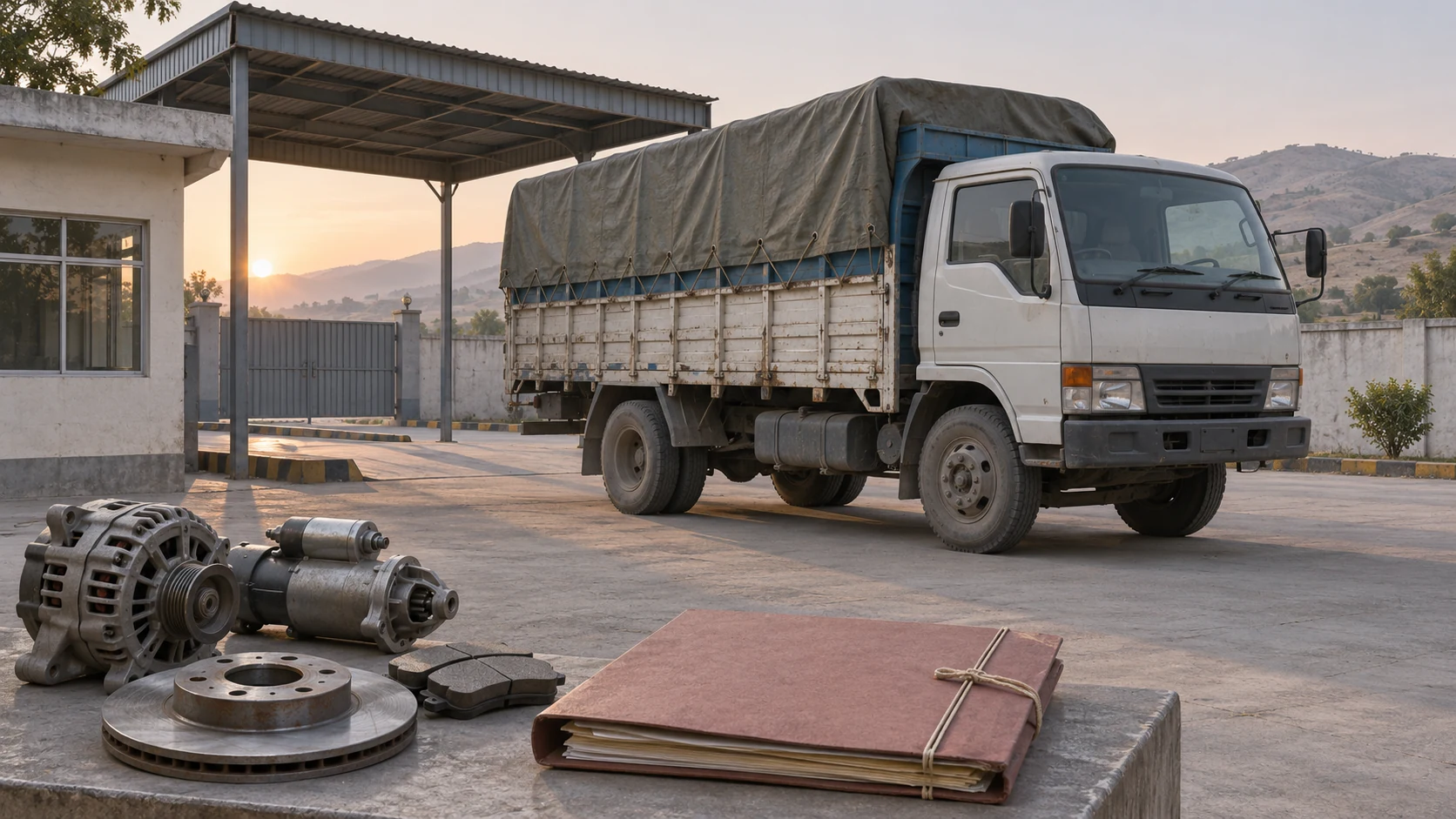
A Customs Appellate Tribunal cannot release a vehicle against a redemption fine when the applicable statutory notification excludes that vehicle from the option. Applying that rule, the Supreme Court of Pakistan set aside permission to release a truck on payment of 40% of its appraised value and restored outright confiscation. Order, paragraphs 3–4 Paragraphs 6–7.
The order in Collector of Customs (Enforcement), Peshawar v. Azad Shah and others is dated 8 October 2026. Justice Muhammad Shafi Siddiqui wrote for a bench comprising Chief Justice Yahya Afridi, himself and Justice Miangul Hassan Aurangzeb. The petition was converted into an appeal and allowed. Case particulars Paragraph 7.
The truck and the 40% redemption order
On 16 February 2025, a Hino Mazda truck was intercepted at JCP Tunnel, Kohat, carrying foreign-origin spare parts. The driver did not produce documents establishing lawful import. The goods were seized under section 168 of the Customs Act, 1969 and the vehicle under section 157(2). The adjudicating authority ordered outright confiscation, which survived the first appeal. Paragraph 2, pages 1–2.
The Customs Appellate Tribunal modified the result on 30 July 2025 by permitting redemption of the vehicle for 40% of its appraised value. The Peshawar High Court maintained that order. The Supreme Court considered whether the Tribunal had legal authority to grant that option under the governing notification. Paragraphs 2–3.
Liability to confiscation does not create a right to redeem
Section 157(2) makes a conveyance used to move the relevant goods liable to confiscation. Section 181 deals separately with an option to pay a fine in lieu of confiscation. Its first proviso empowers the Federal Board of Revenue to specify goods or classes of cases in which the option must not be given. The Tribunal's discretion therefore depends on the statutory restriction. Paragraph 3.
The distinction is decisive. A redemption percentage cannot supply jurisdiction which the notification has removed. The Court rejected an approach which treated the existence of redemption rates as sufficient without first asking whether the vehicle fell within an excluded category. Paragraphs 3–4 Paragraph 4.
The notification's exclusions came before its fine rates
Under SRO 499(I)/2009 of 13 June 2009, clause (b) excludes the specified lawfully registered conveyances carrying goods in false cavities or used wholly or exclusively to transport goods involved in smuggling. The appended rate table cannot be detached from that exclusion. The Court applied the principle stated in Bashir Ahmad, 2025 SCMR 684, that the Tribunal cannot order redemption for a class which the Board has excluded. Paragraph 4, continuing on page 3.
The order then traces the amendments. SRO 1280(I)/2024 of 20 August 2024 temporarily introduced a limited relaxation for certain first- or second-time seizures outside clause (b). SRO 1619(I)/2024 of 3 October 2024 rescinded that relaxation and inserted clause (ba), concerning registered conveyances outside clause (b) which were seized carrying smuggled goods. Paragraph 5.
The Court also relied on Director, Intelligence and Investigation (Customs), FBR, Peshawar v. Muhammad Ishaq, 2026 SCMR 885, as discussed in the order. Its reasoning reaffirmed the restriction and rejected the suggestion that use for public transport could override wording which made no such distinction. Paragraph 5 and footnote 2.
Why the February 2025 seizure fell under the amended restriction
This truck was seized after clause (ba) had been inserted. The Tribunal treated it as lawfully registered, and the adjudicating authority had found the recovered goods liable to confiscation for want of documents evidencing lawful import. The Tribunal therefore had to apply the amended notification, rather than rely on the asserted use of the truck to carry goods for hire. Paragraph 6.
The order does not record a finding that this particular truck contained a false cavity. That feature belongs to the Court's explanation of clause (b), while the later clause (ba) also covered conveyances outside that clause. Adding a concealed compartment to the facts would obscure the actual reason the amended notification mattered. Paragraphs 4–6.
Confiscation restored; the ruling concerns redemption
The Supreme Court set aside the judgments of the High Court and Tribunal and restored the adjudicating authority's outright confiscation order for the vehicle. It disposed of the connected stay application. No criminal conviction or sentence was imposed through this order. Paragraph 7.
For customs litigation, the sequence of inquiry matters: identify the seizure date, the notification then applicable, the vehicle's relevant classification and the established findings about the goods, before debating a redemption rate. This is the practical implication of paragraphs 3–6. The decision applies the notification to the February 2025 seizure; it should not be used as a substitute for checking the law applicable to a different seizure date. Paragraphs 3–6.
Related coverage: vehicle classification and an altered limousine in a separate customs appeal. The classification question in that case should be distinguished from the redemption restriction applied here.
Sources
- Complete Supreme Court judgment.
- Download judgment PDF.
- Case details and searchable judgment summary.
- Customs Act, 1969 — official Trade Information Portal, sections 157, 168 and 181.
- FBR's explanation of the October 2024 confiscation amendment.
Frequently asked questions
Could the truck be released by paying 40% of its value?
No. The Supreme Court set aside that relief because the applicable notification excluded the vehicle from redemption. It restored outright confiscation. paragraphs 6–7.
Does section 181 always give a vehicle owner a redemption option?
No. Its first proviso empowers the Board to exclude goods or classes of cases from the fine option. The Tribunal cannot grant redemption contrary to that restriction. paragraphs 3–4.
What was the significance of the seizure date?
The truck was seized on 16 February 2025, after SRO 1619(I)/2024 inserted clause (ba). The Court required the amended notification to be applied to that seizure. paragraphs 5–6.
Did carrying goods for hire avoid the restriction?
No. The claimed public-transport or hire use could not override the express statutory restriction applicable to this vehicle. paragraphs 5–6.
Did the Court find a false cavity in this truck?
The order does not record such a finding for this truck. It discusses clause (b), but also applies the later clause (ba) covering registered conveyances outside clause (b). A false-cavity finding should not be added to the facts. paragraphs 4–6.
Was this a criminal conviction of the owner or driver?
No criminal conviction is imposed by this order. The Supreme Court decided the customs appeal concerning confiscation of the vehicle and the Tribunal's power to allow redemption. paragraph 7.
New judgment alerts
Follow this court or legal topic
Receive new judgments and analysis about Supreme Court of Pakistan, Commercial Law, Civil Law by email.
Primary-source materials
Verify the underlying law and record
Court documents, statutory provisions, official notifications, government documents, and external official sources relied on or relevant to this article.
Supreme Court Restores Truck Confiscation, Rejects 40% Redemption Fine
customs-truck-confiscation-redemption-fine-azad-shah-supreme-court.pdf · PDF · 363 KB
Collector of Customs (Enforcement), Model Customs Collectorate, Peshawar v. Azad Shah and others
collector-customs-azad-shah-cpla-5420-2025.pdf · PDF · 18 KB
Complete Supreme Court order
FBR explanation of SRO 1619(I)/2024
Research integrity
Editorial and source record
- Author
- Shahbaz Shah, Advocate High Court
- Legal review
- Author-reviewed
- Sources checked
- November 5, 2026
- Primary materials
- 4 recorded on this page
- Corrections
- No material correction note is recorded.
Independent legal journal
Written and published by Shahbaz Shah
This article forms part of an independent journal focused on practical analysis of Pakistani law, courts, and legal institutions.
About the authorReader feedback
Was this analysis useful?
Choose one response and, if you wish, tell us what should be improved. No name or email is required. See the Privacy Policy.