Share this article
For more judgments and legal updates, follow our WhatsApp channel.
Independently written and published by Shahbaz Shah Legal Journal.
Case reference
Deepak Raheja v. Omkara Assets Reconstruction
- Reference
- 2026 INSC 1134 · Civil Appeal 12195/2025, with connected appeal
- Court / judgment
- Supreme Court of India · 15 October 2026 · Reportable
- Bench / author
- Dipankar Datta J. and Augustine George Masih J.; judgment by Masih J.
Alleged fake judgments draw criticism in an insolvency appeal
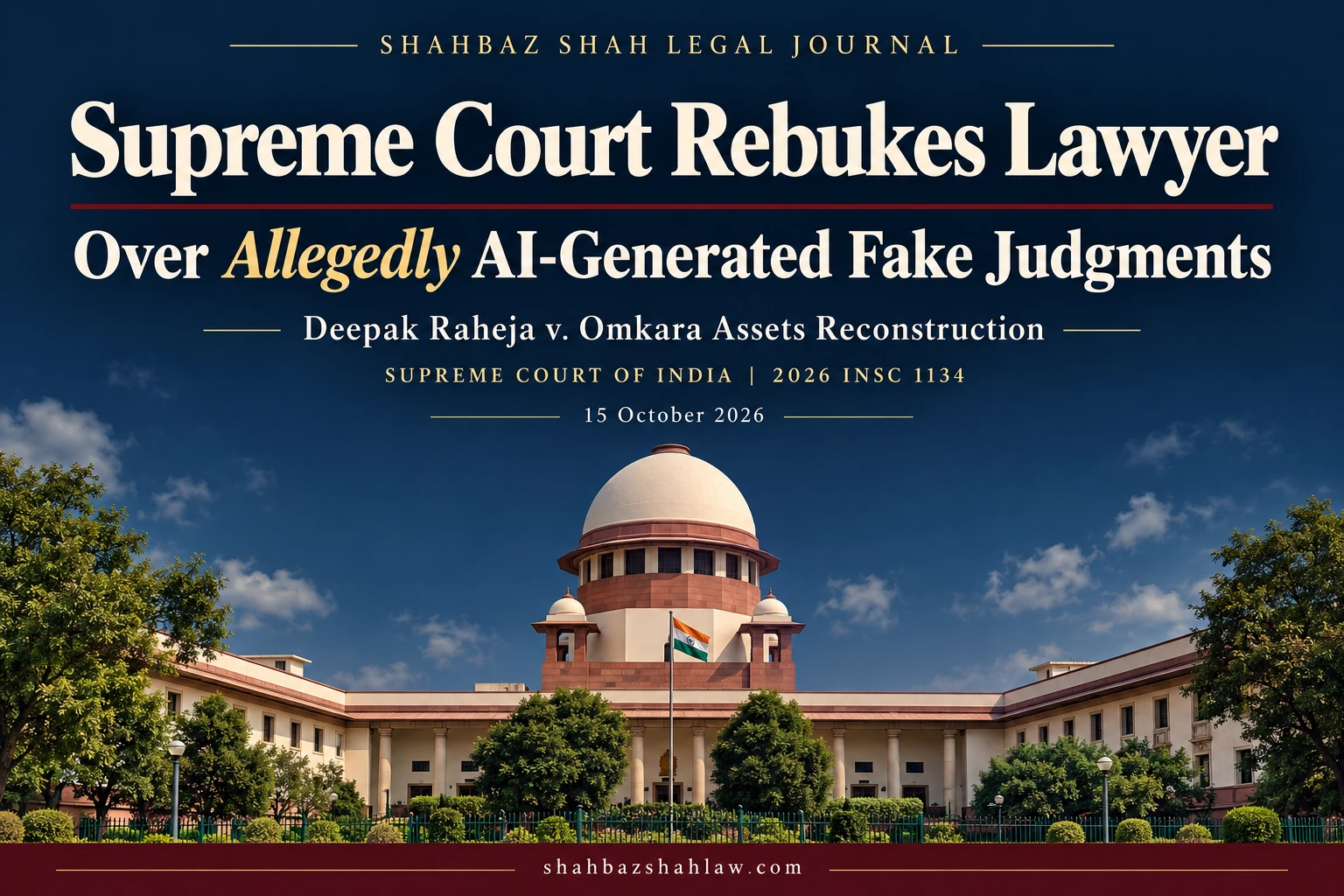
NEW DELHI: The Supreme Court of India has criticised an advocate-on-record for attempting to blame the clients after the respondents objected that a compilation of authorities contained AI-generated, non-existent judgments. The incident is recorded in paragraph 74 of Deepak Raheja and Another v. Omkara Assets Reconstruction Private Ltd. and Another, 2026 INSC 1134.
The reportable judgment was delivered on 15 October 2026 by Justices Dipankar Datta and Augustine George Masih. Justice Masih authored it. The Court heard and dismissed two insolvency appeals on their merits, while recording its concern about the disputed compilation. Judgment, paragraphs 72–74.
The distinction between an allegation and a judicial finding matters here. Paragraph 74 attributes the allegation about AI-generated, non-existent decisions to the respondents. It neither names the allegedly fabricated decisions nor records a separate examination establishing that particular authorities were generated by AI. The criticism of the attempt to shift responsibility is the Court’s own observation. Judgment, paragraph 74.
The lawyer sought to blame the clients
According to the judgment, the respondents raised an immediate and serious objection when the compilation was placed on record. When questioned by the Court, the appellants’ advocate-on-record sought to shift the entire responsibility to the appellants while claiming ignorance of its contents. Senior counsel then accepted blame and sought forgiveness on the appellants’ behalf.
The respondents argued that the conduct disentitled the appellants to a hearing on merits. The Court nevertheless heard the appeals, leaving that objection open. Its eventual dismissal rested on the substantive insolvency analysis, rather than a refusal to consider the case because of the compilation. Judgment, paragraphs 72 and 74.
The paragraph does not identify the advocate-on-record by name. This report therefore does not infer an individual’s responsibility from the lawyers appearing elsewhere in the case record. Nor does it convert the respondents’ allegation into a finding that all the authorities in the compilation were false.
No costs were ultimately imposed
The Court had proposed exemplary costs against the appellants. It explained that it subsequently learnt of the death of the first appellant, Deepak Raheja, and for that reason replaced the proposed costs direction with no order as to costs.
It also recorded that the appeal did not abate in view of Order XXII Rule 6 of the Code of Civil Procedure, 1908, and disposed of any redundant application concerning notice of death and substitution. The judgment does not impose a fine or professional disciplinary sanction on the lawyer. Judgment, paragraphs 73–74.
The underlying dispute concerned two hotel companies
The appeals arose from insolvency proceedings against GSTAAD Hotels Pvt. Ltd., which owns and operates the JW Marriott Hotel at Bangalore, and Neo Capricorn Plaza Pvt. Ltd., which owns and operates the Crowne Plaza Hotel at Pune. A 2017 loan agreement provided facilities aggregating INR 600 crore. Further emergency-credit facilities were subsequently extended, and the debts were assigned to Omkara in December 2022. Judgment, paragraphs 3–7.
Omkara sought admission under Section 7 of India’s Insolvency and Bankruptcy Code, 2016. After an earlier remand, the National Company Law Tribunal, Mumbai, admitted both petitions afresh on 8 July 2025. The National Company Law Appellate Tribunal upheld those orders on 19 August 2025. The borrowers challenged the findings of default, the treatment of reserve and retention accounts, and the initiation of insolvency proceedings against businesses they described as profitable. Judgment, paragraphs 10–25.
Proof of default does not require settling every account entry
The Supreme Court distinguished the occurrence of default from the exact amount ultimately outstanding. Default occurs when a debt, part of it or an instalment becomes payable and remains unpaid. The total balance can then change with interest, payments, charges and adjustments.
At admission under Section 7, the Court held that the tribunal makes a summary assessment on the balance of probabilities from the documentary material. It need not conduct a full trial or reconcile the accounts down to the last rupee. A genuine financial debt and default exceeding the statutory threshold must still be established. Disputes about quantification do not automatically erase an otherwise proved default. Judgment, paragraphs 40–47.
Detailed verification of claims follows during the corporate insolvency resolution process, under the statutory arrangements discussed by the Court. Admission and final quantification therefore answer different questions. Judgment, paragraphs 45–47.
Authenticated information-utility records carry substantial weight
The Court described a hierarchy of evidence. An authenticated record of default issued by an information utility occupies the first tier. Such a record can, by itself, establish default at the admission stage unless displaced by persuasive evidence. The Court expressly stopped short of treating it as irrebuttable proof in the abstract.
At the second tier are other documents, including financial contracts, account statements, balance confirmations, acknowledgements and correspondence. These may collectively demonstrate default under the summary standard. They do not individually receive the same statutory treatment as an authenticated information-utility record. Judgment, paragraphs 48–58.
On the facts, the Court considered both the NeSL records and the wider documentary record. It noted defaults of approximately INR 17.16 crore for GSTAAD and INR 2.65 crore for Neo, comfortably above the statutory threshold. The account disputes and proposed treatment of reserve funds did not disclose an error of law in the concurrent findings. Judgment, paragraphs 59–64.
Profitability did not answer the default finding
The Court rejected the proposition that a profit-earning company necessarily has the cash to service its debt. It explained that EBITDA measures earnings before interest, taxes, depreciation and amortisation, and therefore cannot by itself show whether repayment obligations can be met.
The corporate debtor’s own audited statements recorded a debt-service coverage ratio of 0.12 for 2022–23. The Court said the Code permits timely intervention upon default rather than requiring a creditor to wait for terminal financial collapse. The relevant trigger was default, not a general label of commercial or balance-sheet insolvency. Judgment, paragraphs 65–66.
Assignment, appellate limits and the 2026 amendment
The Court also held that Omkara’s status as financial creditor could not be reopened through a fresh attack on an assignment already litigated to finality. Under Section 62, the Supreme Court’s jurisdiction concerned questions of law; it would not simply reweigh concurrent factual findings unless the recognised grounds for interference were shown. Judgment, paragraphs 27–33.
Paragraphs 67–70 discuss the 2026 amendment to Section 7(5), including mandatory admission where the statutory conditions are satisfied and the sufficiency of the specified information-utility record. The Court described the explanations as clarificatory and said its reasoning would have been the same without the amendment. This report recounts that interpretation in this judgment. Judgment, paragraphs 67–71.
Result and practical significance
Both appeals were dismissed. The Court upheld the NCLT orders as affirmed by the NCLAT and directed that the insolvency resolution processes proceed in accordance with law. Pending applications were disposed of, with no order as to costs. Judgment, paragraphs 72–74.
For legal researchers, the immediate practical lesson is to open and verify each authority before using it: the case title, number, court, date, passage relied upon and actual result. A citation supplied by a client, colleague or AI tool requires the same scrutiny. This is an editorial recommendation drawn from the incident, rather than a separate set of research rules made by the Court. Our editorial standards explain this journal’s approach to checking sources.
For Pakistani readers, the insolvency holdings concern India’s statutory framework and should not be presented as rules governing Pakistani proceedings. Their comparative value lies in the distinction between evidence of default and final quantification. The concern about verified authorities is relevant to research practice across jurisdictions, while the legal effect of a foreign decision must be assessed separately.
Sources
- Supreme Court of India — complete official 50-page judgment, 2026 INSC 1134.
- Supreme Court of India — official judgment viewer and case/date reference.
- Supreme Court of India — official judgment-date search. Search 15 October 2026, Civil Appeal 12195/2025, or Diary 53549/2025.
- Downloadable copy of the unchanged official judgment.
- Judgment summary and case particulars.
Frequently asked questions
What did the Supreme Court say about the allegedly AI-generated judgments?
Paragraph 74 records the respondents’ allegation that the compilation contained AI-generated, non-existent decisions. The Court criticised the advocate-on-record’s attempt to shift responsibility to the appellants. It did not identify particular false decisions or make a separate finding proving their AI origin. Judgment, paragraphs 74.
Did the Court fine the lawyer or the appellants?
No. The Court considered exemplary costs against the appellants but ultimately made no order as to costs after learning of the first appellant’s death. The judgment does not impose a fine or disciplinary sanction on the lawyer. Judgment, paragraphs 73–74.
Were the appeals dismissed because of the disputed citations?
The Court heard the appeals on their merits and dismissed them for the insolvency reasons explained in the judgment. It upheld the orders initiating the corporate insolvency resolution process against both companies. Judgment, paragraphs 72–74.
Can an information-utility record establish default by itself?
The Court held that an authenticated record of default carries high evidentiary weight and can by itself establish default at the Section 7 admission stage. It is rebuttable through compelling material; a bare denial or accounting disagreement is insufficient. Judgment, paragraphs 51–58.
Can a profitable company still face insolvency proceedings?
Yes, under the Indian framework applied in this case, profitability does not prevent admission when a financial debt and default above the statutory threshold are established and the other admission conditions are satisfied. Judgment, paragraphs 65–71.
Does this judgment ban lawyers from using AI?
Paragraph 74 does not announce a general ban on AI-assisted research. The practical lesson is to verify every authority before filing it. That is an editorial inference from the incident, rather than a new AI-use code issued by the Court. Judgment, paragraphs 74.
New judgment alerts
Follow this court or legal topic
Receive new judgments and analysis about Supreme Court of India, Commercial Law, Legal Profession by email.
Primary-source materials
Verify the underlying law and record
Court documents, statutory provisions, official notifications, government documents, and external official sources relied on or relevant to this article.
Deepak Raheja and Another v. Omkara Assets Reconstruction Private Ltd. and Another
deepak-raheja-omkara-2026-insc-1134-official-judgment.pdf · PDF · 362 KB
Supreme Court of India — official 50-page judgment, 15 October 2026
Supreme Court of India — official judgment viewer, Civil Appeal 12195/2025
Supreme Court of India — official judgment-date search
Research integrity
Editorial and source record
- Author
- Shahbaz Shah, Advocate High Court
- Legal review
- Author-reviewed
- Sources checked
- October 22, 2026
- Primary materials
- 4 recorded on this page
- Corrections
- No material correction note is recorded.
Independent legal journal
Written and published by Shahbaz Shah
This article forms part of an independent journal focused on practical analysis of Pakistani law, courts, and legal institutions.
About the authorReader feedback
Was this analysis useful?
Choose one response and, if you wish, tell us what should be improved. No name or email is required. See the Privacy Policy.