Share this article
For more judgments and legal updates, follow our WhatsApp channel.
Independently written and published by Shahbaz Shah Legal Journal.
Case reference
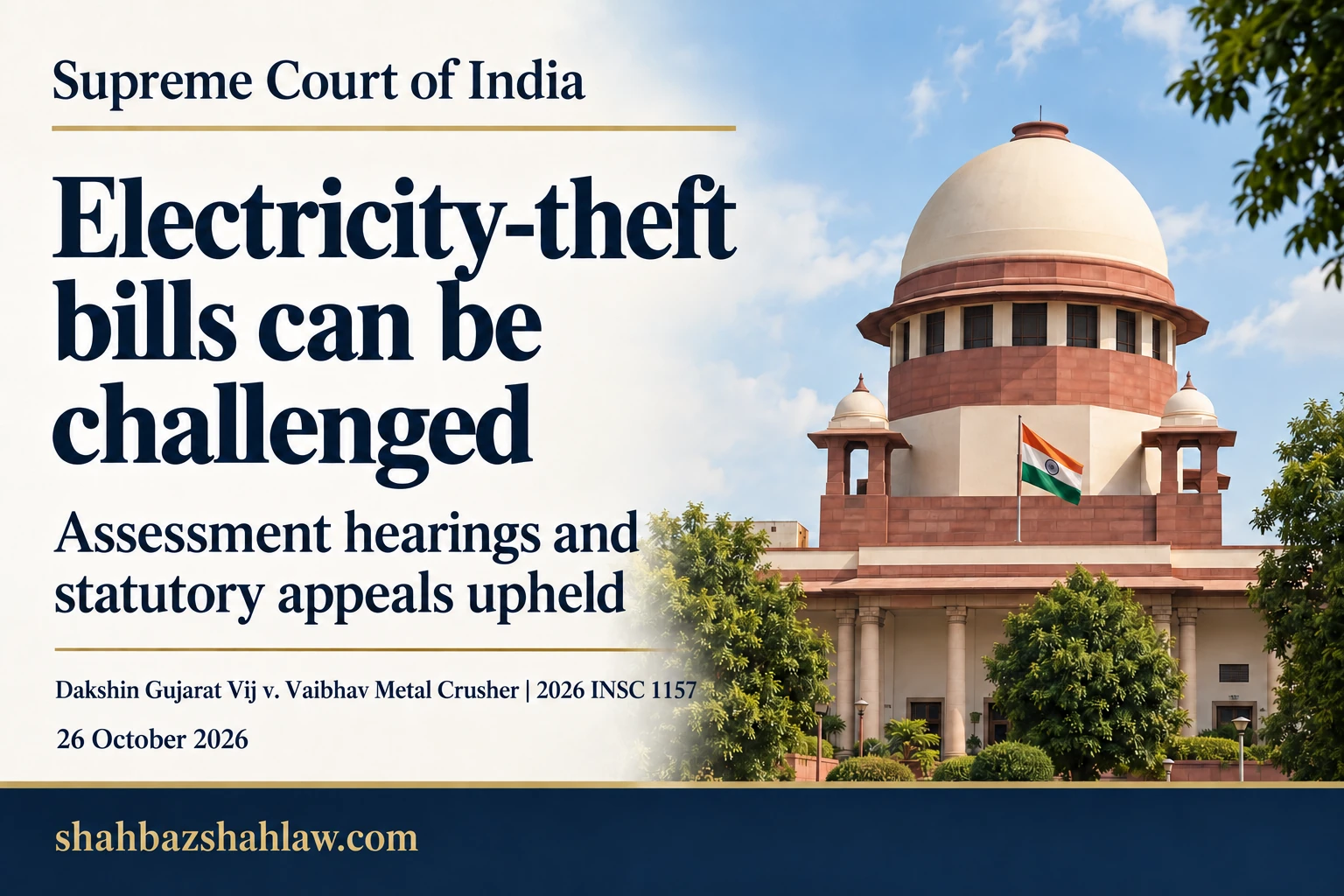
Dakshin Gujarat Vij v. Vaibhav Metal Crusher
- Reference
- 2026 INSC 1157 · SLP (C) 17868/2024 & 8778/2025
- Court / date
- Supreme Court of India · 26 October 2026
An allegation of theft does not remove the assessment safeguards
The Supreme Court of India has upheld a consumer’s right to object to an electricity-theft assessment and pursue an appeal when the amount is being determined for restoration of disconnected supply. In the absence of a specific procedure under the applicable Supply Code, the safeguards of section 126 of the Electricity Act, 2003 apply, followed by an appeal under section 127. Judgment, paragraphs 31 and 35–37.
The Court also preserved a separate function for the Special Court. Where a criminal complaint is filed, the administrative assessment and appeal do not finally decide the consumer’s civil liability for theft. That determination remains with the Special Court under section 154(5). Judgment, paragraphs 33 and 35–37.
Both appeals by the Gujarat electricity distribution companies were dismissed. The ruling protects a meaningful opportunity to dispute an assessment while keeping the consequences of alleged theft and the Special Court’s powers intact. Judgment, paragraphs 37 and 41–42.
Two supplementary bills brought the issue before the Court
In the Vaibhav Metal Crusher matter, the distribution company issued a supplementary bill demanding approximately ₹92.99 lakh for alleged theft and approximately ₹23.45 lakh as compounding charges. The Gujarat High Court initially allowed reconnection on deposit of 50% of the bill amount and reconnection charges. Its Division Bench later permitted objections before the Executive Engineer, followed by the statutory appeal remedy. Judgment, paragraph 4.
The connected case concerned Jamanbhai Nanajibhai Bhuva. A Single Judge had ordered interim protection on a 50% deposit and allowed an application for a fresh connection. The Division Bench remitted that matter to the Single Judge for reconsideration. Judgment, paragraph 5.
The distribution companies argued that theft and unauthorised use fall under different statutory provisions, that section 126 objections and section 127 appeals were unavailable in theft cases, and that the Special Court alone should determine civil liability. They also challenged the use of a 50% deposit for interim reconnection. Judgment, paragraphs 7–8.
How sections 126, 135 and 154 work together
Section 126 provides a process for assessing charges for unauthorised electricity use. That process includes provisional assessment, service of the order, an opportunity to object and a hearing before final assessment. Section 127 provides the appeal route against a final assessment. Judgment, paragraphs 13–14.
Section 135 addresses theft, including immediate disconnection on detection. Its third proviso to subsection (1A) requires restoration within 48 hours of deposit or payment of the assessed amount or electricity charges in accordance with the Act. The obligation to lodge a criminal complaint remains. Judgment, paragraph 15.
Section 154 gives the Special Court power to determine civil liability in theft cases. If that liability is less than the amount already deposited, subsection (6) provides for return of the excess in the terms stated by the statute. Judgment, paragraph 18.
The Supreme Court read these provisions together. Theft includes unauthorised use, although every instance of unauthorised use is not theft. The existence of criminal proceedings does not prevent an assessment for the distinct purpose of restoring supply. Judgment, paragraphs 30–34.
Why a hearing must precede final assessment
The companies could not identify a separate statutory assessment process displacing section 126 for the situation before the Court. The Gujarat Supply Code used the same assessment formula for theft and unauthorised use. The Court therefore read the assessed amount required for reconnection as an amount determined through section 126’s procedure, until a separate applicable procedure is prescribed. Judgment, paragraphs 29–31 and 34.
That conclusion brings procedural rights with it. A consumer must receive the provisional assessment and have a reasonable opportunity to contest it before a final order is made. The allegation of theft does not, by itself, permit the final financial assessment to be made without that opportunity. Judgment, paragraphs 31 and 35–37.
The ruling does not require the licensee to postpone an immediate disconnection until after this assessment hearing. It concerns the process for determining the amount payable to obtain restoration under the third proviso to section 135(1A). Judgment, paragraphs 15, 31 and 36–37.
An appeal decides the reconnection amount, not the criminal case
The distribution companies argued that finality under section 127(4) would undermine the Special Court’s later determination. The Supreme Court rejected that objection by explaining the limited purpose of the administrative appeal’s finality. Judgment, paragraphs 35–36.
The appellate assessment is final for the amount required to restore supply. Where a theft complaint is prosecuted, it does not bind the Special Court’s determination of civil liability under section 154(5). If the consumer has paid more than that liability, the excess must be refunded under section 154(6). Judgment, paragraphs 35–37.
Nor does an assessment decide criminal guilt. The judgment, discussing the earlier Orion Metal decision, distinguishes the proof required in a criminal prosecution, including proof of criminal intent, from the assessment of charges. Judgment, paragraph 32.
A 50% deposit is not an automatic reconnection rule
The Supreme Court recognised that electricity is essential to life and livelihood, and that an arbitrary provisional demand can require constitutional protection. It also warned that theft allegations involve criminal intent and must be approached carefully. A High Court may require the entire provisionally assessed amount where the facts warrant that course. Judgment, paragraphs 38–39.
Where the provisional assessment is prima facie arbitrary and the full assessment process will take time, the High Court may order restoration for recorded reasons on deposit of an amount that must not be less than 50% of the demand. The Court linked that floor to the statutory half-deposit requirement for a section 127 appeal. Judgment, paragraph 40.
That is a power to grant reasoned interim relief in an appropriate case. It does not mean that every person accused of electricity theft is entitled to reconnection merely by tendering half the bill. The facts, the apparent arbitrariness of the assessment and the court’s reasons matter. Judgment, paragraphs 39–40.
In Vaibhav Metal Crusher’s case, the Supreme Court held that the High Court acted within its jurisdiction. It clarified that the assessment remained subject first to appeal and ultimately, if prosecution followed, to the Special Court’s civil-liability determination. The remand order in the connected case was also left intact. Judgment, paragraph 41 and the concluding orders.
What the ruling changes for a disputed demand
The immediate practical question is which amount must be paid for restoration while the allegation of theft is being dealt with. The judgment gives that question an assessment and appeal process rather than requiring the consumer to await the conclusion of the criminal case. It simultaneously preserves the Special Court’s later authority. Judgment, paragraphs 34–37.
A challenge should therefore distinguish three issues: the calculation and assessment procedure, the conditions for any interim reconnection, and the ultimate civil and criminal consequences. Treating one interim deposit as a final settlement of all three would misread the decision. Judgment, paragraphs 35–41.
This is a ruling under India’s Electricity Act, 2003 and the Supply Code considered by the Court. It does not decide the procedures governing Pakistani distribution companies. The judgment record contains the full case particulars and the complete PDF.
Sources
- Dakshin Gujarat Vij Company Limited & another v. Vaibhav Metal Crusher; with Paschim Gujarat Vij Company Limited & another v. Jamanbhai Nanajibhai Bhuva — 2026 INSC 1157, Supreme Court of India, 26 October 2026.
- Official Supreme Court judgment record.
- Supreme Court of India judgment search.
Frequently asked questions
Can a person accused of electricity theft object to the assessment?
Yes. In the absence of a specific Supply Code procedure, the section 126 assessment safeguards apply to the amount required for restoration, including an opportunity to object and a hearing.
Is a section 127 appeal available?
Yes. The assessed amount is subject to appeal. In a theft case with a criminal complaint, the appellate result is final only for restoration and does not bind the Special Court’s civil-liability decision.
Must every consumer be reconnected after paying 50%?
No. The Court permitted reasoned interim relief where the provisional assessment is prima facie arbitrary, with a deposit of at least 50%. It also recognised that the full amount may be required on the facts.
Does reconnection end the theft prosecution?
No. Restoration and the administrative assessment do not remove the criminal process or the Special Court’s power to determine civil liability.
What happens if the final civil liability is less than the deposit?
The excess is refundable under section 154(6) on the terms provided by that provision.
New judgment alerts
Follow this court or legal topic
Receive new judgments and analysis about Supreme Court of India, Civil Law, Commercial Law by email.
Primary-source materials
Verify the underlying law and record
Court documents, statutory provisions, official notifications, government documents, and external official sources relied on or relevant to this article.
Dakshin Gujarat Vij Company Limited & another v. Vaibhav Metal Crusher; with Paschim Gujarat Vij Company Limited & another v. Jamanbhai Nanajibhai Bhuva
electricity-theft-bill-hearing-appeal-section-126-supreme-court-india.pdf · PDF · 298 KB
Dakshin Gujarat Vij Company Limited & another v. Vaibhav Metal Crusher; with Paschim Gujarat Vij Company Limited & another v. Jamanbhai Nanajibhai Bhuva — complete judgment
Supreme Court of India — official judgment record
Supreme Court of India — judgment search
Research integrity
Editorial and source record
- Author
- Shahbaz Shah, Advocate High Court
- Legal review
- Author-reviewed
- Sources checked
- October 26, 2026
- Primary materials
- 4 recorded on this page
- Corrections
- No material correction note is recorded.
Independent legal journal
Written and published by Shahbaz Shah
This article forms part of an independent journal focused on practical analysis of Pakistani law, courts, and legal institutions.
About the authorReader feedback
Was this analysis useful?
Choose one response and, if you wish, tell us what should be improved. No name or email is required. See the Privacy Policy.