Share this article
For more judgments and legal updates, follow our WhatsApp channel.
Independently written and published by Shahbaz Shah Legal Journal.
Case reference
Muppathadam Bank v. State Information Commissioner
- Reference
- 2026 INSC 1153 · C.A. 13906–13907/2026
- Court / date
- Supreme Court of India · 26 October 2026
A private bank’s records can still be accessible through a public authority
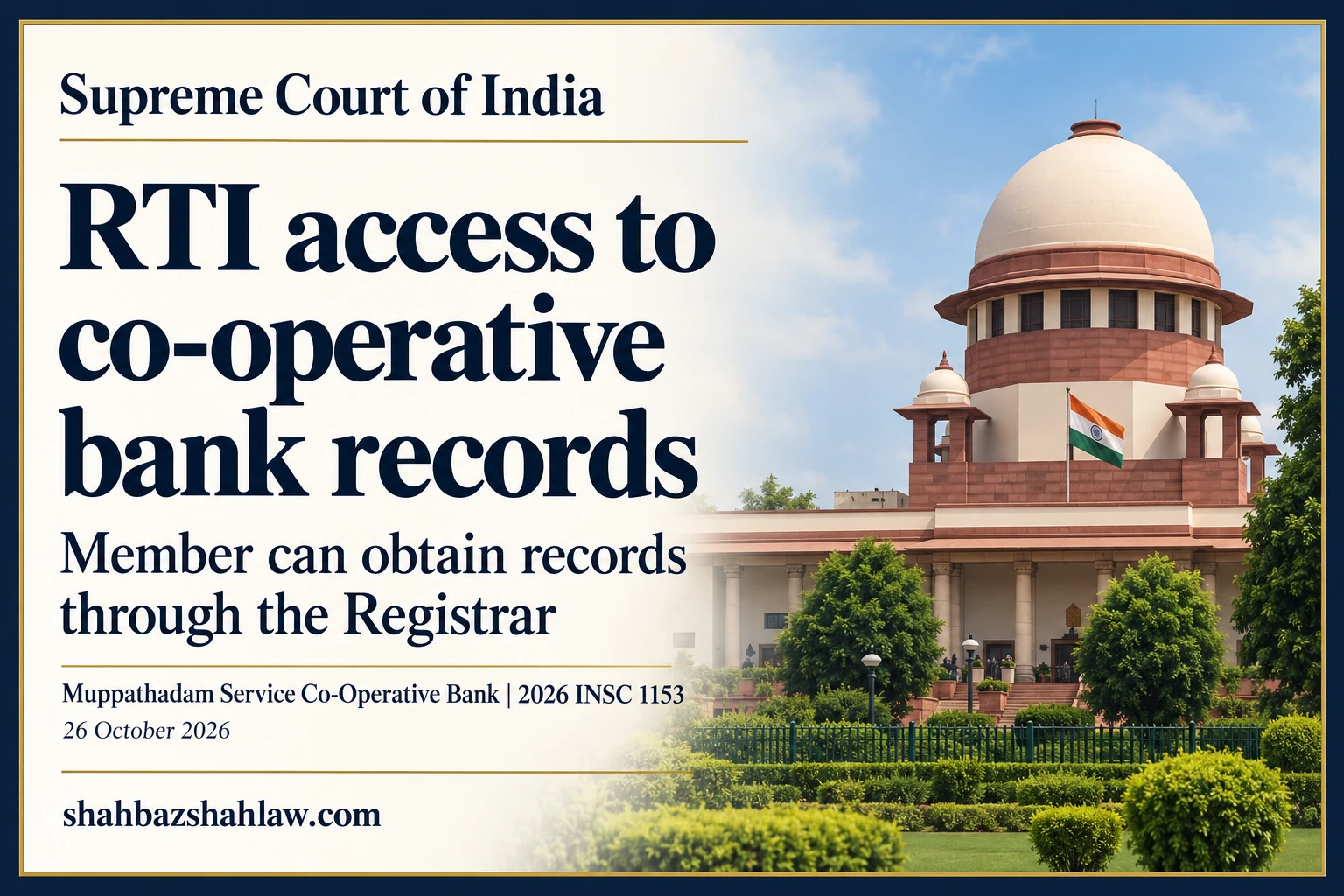
The Supreme Court of India has upheld a co-operative bank member’s right to obtain two records under the Right to Information Act, 2005: the bank’s building-construction agreement and the minutes of its last General Body Meeting. The route was an application to the Joint Registrar of Co-operative Societies, whose statutory powers allowed access to those records. Judgment, paragraphs 2 and 11–16.
The decision does not turn every co-operative society into a public authority. It explains a separate question: whether a public authority can obtain information about a private body under another law and make it available through RTI, subject to the Act’s exemptions. Judgment, paragraphs 4 and 10–13.
The Court dismissed the bank’s two appeals and directed the Joint Registrar to call for both documents immediately, and in any event within two weeks, and supply them to the member. Judgment, paragraphs 15–16.
What the member requested
The applicant was a member of Muppathadam Service Co-Operative Bank. He sought the agreement between the bank and the Labour Co-operative Society engaged to construct a building, together with the minutes of the last General Body Meeting. His initial request failed before the authorities and a Single Judge, but a Division Bench ordered reconsideration. In the next round, the authorities and the High Court upheld his entitlement. Judgment, paragraph 2.
Before the Supreme Court, the bank argued that it was not a public authority under section 2(h) of the RTI Act. It also argued that the Registrar could access its records only after recording satisfaction that an inquiry should be initiated under the Kerala Co-operative Societies Act, 1969. No such inquiry was pending. Judgment, paragraph 3.
That argument would have made the right to request information depend on the Registrar first starting a different statutory process. The Court rejected that reading of the Registrar’s access and supervision powers. Judgment, paragraphs 12–15.
Section 2(f) reaches beyond physical custody
Section 2(f), as applied in the judgment, includes information relating to a private body which a public authority can access under another law. The Registrar did not need to have the documents physically on file when the RTI application arrived. The legal power to obtain them was material. Judgment, paragraphs 11–12.
This distinction is central to the result. A public authority’s existing possession of a record and its statutory entitlement to obtain that record are different ways in which information may come within the Act. The bank could not defeat the request simply by keeping the documents in its own office. Judgment, paragraphs 4, 6 and 12.
The Court discussed Thalappalam Service Cooperative Bank Ltd. v. State of Kerala, (2013) 16 SCC 82, and the Constitution Bench decision in Central Public Information Officer, Supreme Court of India v. Subhash Chandra Agarwal, (2020) 5 SCC 481. As explained in this judgment, those decisions preserve lawful statutory access to private-body information while recognising the relevance of access conditions and exemptions. Judgment, paragraphs 10–13.
Why a prior inquiry was unnecessary
The bank’s reading of section 65 put the steps in the wrong order. The Registrar may need to inspect records to decide whether there is any basis for an inquiry. Requiring a completed decision to initiate an inquiry before allowing access would deprive the Registrar of the material needed to reach that decision. Judgment, paragraphs 13–14.
The Supreme Court explained that satisfaction about the need for an inquiry cannot be reached in a vacuum. Section 65(2) provides access to the society’s books, accounts and documents at reasonable times. Section 66 independently supplies powers of supervision and inspection, including inspection of the society’s books. Judgment, paragraphs 14–15.
The Court did not hold that every legal condition on access disappears when an RTI application is filed. It explained that where another law imposes a condition or restriction, access becomes available when the condition is met or the restriction is removed. For the records and statutory powers before it, no prior-inquiry barrier applied. Judgment, paragraph 13.
Commercial confidence did not protect these two documents
The bank relied on section 8(1)(d), concerning commercial confidence, trade secrets and intellectual property where disclosure would harm a third party’s competitive position. The Court found no such protected interest established for the requested records. The bidding process had ended and the construction contract had already been awarded. Judgment, paragraphs 7–8.
The applicant’s interest as a bank member was significant. The terms of the construction agreement concerned the institution to which he belonged. The Court did not treat a commercial setting, by itself, as sufficient reason to withhold the agreement. Judgment, paragraph 8.
That reasoning concerns these documents and these circumstances. It should not be stretched into a claim that every completed contract must always be disclosed regardless of its contents or the applicable exemption. Judgment, paragraphs 7–10.
The member’s position mattered under the personal-information exemption
The Court also rejected reliance on section 8(1)(j). A member seeking his society’s construction agreement and General Body minutes could not be refused merely because the records were described as personal to the society or unrelated to a public activity. Judgment, paragraphs 8–9.
The Court expressly distinguished an unconnected third party. It explained that information about a private entity may raise different concerns where the requester has no connection with its affairs and no relevant relationship to public activity. The decision therefore does not give every citizen unrestricted access to every co-operative bank record. Judgment, paragraph 9.
Nor does it authorise disclosure of members’ bank-account deposits. The judgment distinguished the deposit information considered in Thalappalam from the institutional contract and meeting minutes requested here. Judgment, paragraph 10.
What an effective request needs to identify
The judgment suggests a clear method for an Indian RTI request involving a private body: identify the records, the public authority with statutory access, and the provision giving that authority access. Then address the exemption actually raised against those records. The decisive inquiry goes beyond whether the private body itself is a public authority. Judgment, paragraphs 10–15.
For this member, the result is concrete: the Registrar must obtain and supply the two documents. For other applicants, the scope of the access power, the nature of the information and the applicable exemptions still matter. Judgment, paragraphs 9–16.
This is an Indian RTI ruling under Indian and Kerala legislation. It does not decide the scope of Pakistan’s federal or provincial information laws. Readers researching Pakistani information access can separately consult our Pakistan Information Commission analysis concerning National Assembly records.
Sources
- The Muppathadam Service Co-Operative Bank Ltd. v. The State Chief Information Commissioner & others — 2026 INSC 1153, Supreme Court of India, 26 October 2026.
- Official Supreme Court judgment record.
- Supreme Court of India judgment search.
Frequently asked questions
Did the Court declare every co-operative bank a public authority?
No. It upheld access through the Registrar’s statutory powers. The distinction between the bank’s status and the public authority’s access to its records remains important.
Which records had to be supplied?
The building-construction agreement with the Labour Co-operative Society and the minutes of the bank’s last General Body Meeting.
Must the Registrar begin an inquiry before obtaining these records?
No. Under the provisions applied, access could be used to decide whether an inquiry was needed; supervision and inspection powers also supported access.
Can an unrelated outsider demand exactly the same records?
The Court expressly said the position would differ for an unconnected third party. It did not recognise unrestricted access to all private-entity records.
Does this judgment directly govern Pakistan’s RTI laws?
No. It interprets India’s RTI Act, 2005 and the Kerala Co-operative Societies Act, 1969. Pakistani claims require examination of the applicable Pakistani law.
New judgment alerts
Follow this court or legal topic
Receive new judgments and analysis about Supreme Court of India, Constitutional Law, Commercial Law by email.
Primary-source materials
Verify the underlying law and record
Court documents, statutory provisions, official notifications, government documents, and external official sources relied on or relevant to this article.
The Muppathadam Service Co-Operative Bank Ltd. v. The State Chief Information Commissioner & others
muppathadam-bank-rti-member-records-registrar-supreme-court-india.pdf · PDF · 178 KB
The Muppathadam Service Co-Operative Bank Ltd. v. The State Chief Information Commissioner & others — complete judgment
Supreme Court of India — official judgment record
Supreme Court of India — judgment search
Research integrity
Editorial and source record
- Author
- Shahbaz Shah, Advocate High Court
- Legal review
- Author-reviewed
- Sources checked
- October 26, 2026
- Primary materials
- 4 recorded on this page
- Corrections
- No material correction note is recorded.
Independent legal journal
Written and published by Shahbaz Shah
This article forms part of an independent journal focused on practical analysis of Pakistani law, courts, and legal institutions.
About the authorReader feedback
Was this analysis useful?
Choose one response and, if you wish, tell us what should be improved. No name or email is required. See the Privacy Policy.