Share this article
For more judgments and legal updates, follow our WhatsApp channel.
Independently written and published by Shahbaz Shah Legal Journal.
Case reference
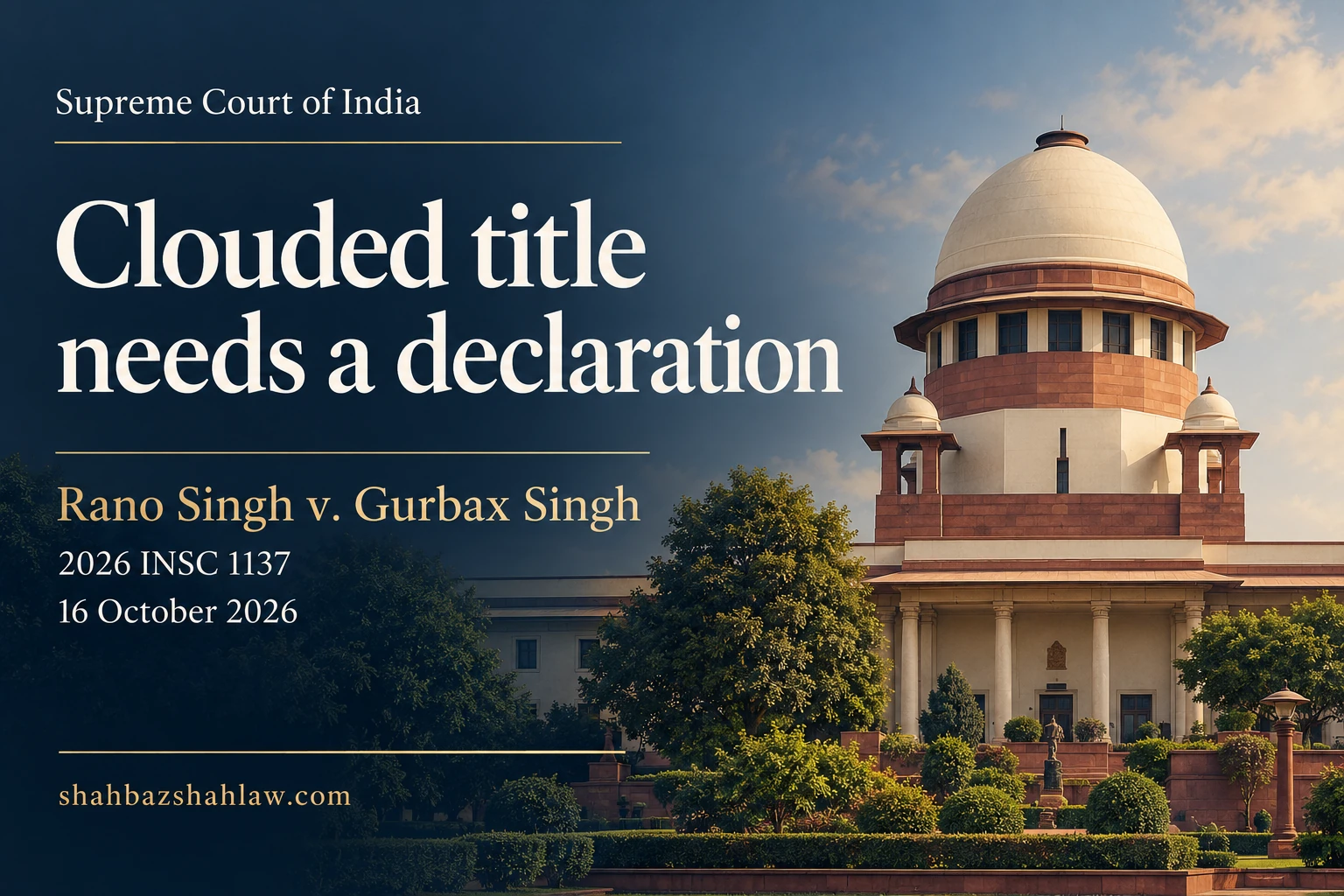
Rano Singh v. Gurbax Singh
- Reference
- C.A. 7025/2012 · 2026 INSC 1137
- Court / date
- Supreme Court of India · 16 October 2026
A serious title dispute changes the relief a claimant must seek
The Supreme Court of India has upheld the dismissal of a possession suit brought by the heirs of an original housing-society allottee. Their predecessor held an agreement to sell, but the defendant held a registered sale deed. That competing deed created a serious cloud over the plaintiffs’ asserted title, which a bare prayer for possession could not resolve. Appropriate declaratory relief was required. Judgment, paragraphs 48–53 and 68–70.
In Rano Singh v. Gurbax Singh, the Court also found the claim time-barred. The original allottee had asked for the plot to be transferred to Gurbax Singh after expressing his inability to fulfil a mandatory construction condition. The Court rejected the heirs’ attempt to recover the property through the abandoned agreement and found the requirements of part-performance unmet. Judgment, paragraphs 39–47 and 58–70.
The qualification matters: a declaration is not necessary every time a defendant disputes ownership. The Court distinguished a serious, evidence-backed cloud on title from a bare denial by someone with no apparent competing title. Judgment, paragraphs 49–51.
The Delhi property and the two competing accounts
The dispute concerned Plot No. 8, Friends Colony, New Delhi, measuring approximately 4,132 square yards, together with the house built on it. Sohan Singh became a member of the housing society in 1950. Under an agreement to sell dated 14 January 1952, the plot was allotted to him on the condition that he construct a house within three years. Judgment, paragraphs 5–6.
His heirs maintained that Sohan Singh had entrusted the property and construction work to his close friend and business associate, Sobha Singh, as an agent. They alleged that the society’s eventual transfer to Sobha Singh’s son, Gurbax Singh, was fraudulent and collusive. Those were the plaintiffs’ allegations, not findings accepted by the Supreme Court. Judgment, paragraphs 7–9 and 63.
Gurbax Singh relied on Sohan Singh’s letter of 4 October 1954 requesting transfer of the plot to him. His case was that the society acted on that request, that he paid the outstanding dues, and that he constructed the house from his own funds. The society executed a registered sale deed in his favour on 3 December 1960. The Court accepted the significance of the transfer request, the construction and the registered conveyance in rejecting the heirs’ claim. Judgment, paragraphs 11–14 and 43–47.
How the possession suit reached the Supreme Court
The dispute first went through cooperative proceedings. The society later filed its own civil suit seeking a declaration supporting the sale deed. The heirs instituted their suit for possession and mesne profits on 22 May 1975. The two suits were consolidated for trial; although the society’s suit was dismissed for default, its recorded evidence was preserved for deciding the heirs’ suit. Judgment, paragraphs 17 and 33.
The Trial Court dismissed the possession suit on 14 January 2010. It had nevertheless treated the suit as maintainable and within limitation. The Delhi High Court affirmed dismissal on 2 February 2012, taking a different view on limitation. The Supreme Court examined those issues independently before dismissing Civil Appeal No. 7025 of 2012 on 16 October 2026. Judgment, paragraphs 2, 19–29, 32 and 69–70.
That procedural distinction is useful. The Supreme Court upheld the final dismissal without endorsing every intermediate conclusion reached by the Trial Court. In particular, it rejected the Trial Court’s view that a simple possession prayer was sufficient in the face of the registered deed. Judgment, paragraphs 48 and 53.
When does a possession suit require a declaration?
The Court applied Anathula Sudhakar v. P. Buchi Reddy, (2008) 4 SCC 594. As explained in this judgment, a cloud arises where an apparent defect in the claimant’s title or a prima facie competing right is established. A declaration addresses that obstacle. A trespasser’s unsupported denial of an otherwise clear title does not automatically create such a cloud. Judgment, paragraph 49.
The Court also discussed Kurella Naga Druva Vudaya Bhaskara Rao v. Galla Jani Kamma, (2008) 15 SCC 150. A mere assertion of adverse possession by a defendant does not necessarily require a plaintiff with clear documentary title to add a declaration claim. The quality of the competing claim matters. Judgment, paragraphs 50–51.
Here, the defendant did considerably more than deny the plaintiffs’ case. He produced a registered sale deed from the society, supported by the earlier transfer request and subsequent conduct. The heirs, by contrast, relied on their predecessor’s agreement to sell. The Court held that they needed substantive relief addressing the deed and their claimed ownership, or an appropriate specific-performance claim, rather than possession alone. Judgment, paragraphs 52–53.
This was a decision after examination of the record. It should not be read as permitting a defendant to defeat any plaint simply by alleging a rival title. For a separate Indian decision concerning the narrower threshold under Order VII Rule 11 CPC, see our analysis of Sheo Kumar Singh and an unregistered lease deed.
An agreement to sell and ownership are different rights
Section 54 of the Transfer of Property Act, 1882 was central to the Court’s reasoning. An agreement to sell records a contract for a future sale; it does not itself create an interest in or charge on the property. The Court relied on Rambhau Namdeo Gajre, (2004) 8 SCC 614, and Suraj Lamp and Industries, (2012) 1 SCC 656, in distinguishing that contractual position from ownership conveyed by a registered sale deed. Judgment, paragraphs 44–45.
An agreement can support a legally available contractual remedy. It does not, by itself, prove that the proposed buyer has already become the owner. That difference was decisive here because Sohan Singh’s agreement never culminated in a registered conveyance in his favour, and he had abandoned the mandatory construction obligation while requesting transfer to Gurbax Singh. Judgment, paragraphs 43–47.
The heirs also relied on a society resolution which they said recognised Sohan Singh’s ownership. The Court held that a recital in the resolution could not substitute for the conveyance that had never been executed in his favour. Judgment, paragraph 46.
Why the claim failed on limitation
The Court said limitation alone justified rejecting the plaintiffs’ case, but went on to decide the merits as well. Its limitation discussion separated the possible remedies and the events relevant to each. Judgment, paragraphs 38–42.
Specific performance: Article 54
The heirs had not actually sought specific performance. The Court considered it as an alternative route which might have been pleaded and held that it would also have been too late. Article 54 of India’s Limitation Act, 1963 provides three years from the date fixed for performance, or, if none is fixed, from notice that performance is refused. Even using the plaintiffs’ claimed knowledge of the competing sale in 1963, their suit in 1975 came long after the three-year period discussed by the Court. Judgment, paragraph 39.
Cancellation of the deed: Article 59
For relief against the registered deed, the Court considered Article 59’s three-year period from knowledge of the facts entitling the claimant to cancellation or setting aside. It held that even the later knowledge date relied on by the plaintiffs, 23 May 1963, took the deadline only to 1966. The possession suit was instituted in 1975 without the necessary challenge to the deed. Judgment, paragraph 40.
The important trigger is knowledge of the relevant facts, not a rule that every cancellation claim invariably runs from registration alone. The Court considered the different asserted dates and found the claim late even on the plaintiffs’ more favourable version. Judgment, paragraphs 34 and 40.
Previous possession: Article 64
The Court also examined section 27 with Article 64, which concerns possession founded on previous possession rather than title. It explained that the plaintiffs needed to establish both prior possession and subsequent dispossession. On the accepted facts, Sohan Singh had requested the transfer; there was no wrongful dispossession of the kind asserted. Judgment, paragraph 41(a)–(c).
The Court further found that the twelve-year route could not save the suit on the alternative dates considered. This is not a holding that every immovable-property suit has the same limitation period. The applicable article depends on the right and relief actually asserted. Judgment, paragraphs 35 and 41.
The earlier cooperative proceedings and the society’s suit did not persuade the Supreme Court that the heirs’ 1975 suit was timely. The judgment does not establish a general rule abolishing statutory exclusions of time; its conclusion concerns the chronology and claims before it. Judgment, paragraphs 20, 33 and 38–42.
The letter also supported estoppel and acquiescence
Under section 115 of the Indian Evidence Act, 1872, as applied in this litigation, the Court examined a factual representation, reliance on it, an alteration of position and the unfairness of requiring a return to the original position. It drew those requirements from Pratima Chowdhury v. Kalpana Mukherjee, (2014) 4 SCC 196. Judgment, paragraphs 55–57.
The representation here was the written request to transfer the plot. The society acted on it; Gurbax Singh constructed the house and obtained the registered deed. The Court held that Sohan Singh and those claiming through him could not later deny the position he had induced others to accept and act upon. Judgment, paragraphs 58–59.
Acquiescence added a point about conduct. The Court distinguished it from the mere passage of time. Sohan Singh had consciously expressed his inability to build, requested the transfer, and never revoked or challenged that letter during his lifetime. The Court treated this as direct acquiescence in the consequences of the transfer request. Judgment, paragraphs 60–63.
The ruling therefore rests on affirmative conduct and reliance, not simply silence for a certain number of years. Nor did the Court treat an unproved accusation of fraud as sufficient to overcome the evidence: it declined to pursue that issue because cogent evidence of fraud had not been established before the courts below. Judgment, paragraphs 58–63.
Section 53A did not restore the abandoned claim
The heirs invoked part-performance under section 53A of the Transfer of Property Act. The Court identified the requirements of a sufficiently certain written contract, possession taken or continued in part-performance, an act furthering the contract, and performance or willingness to perform the claimant’s own obligations. Judgment, paragraphs 64–65.
Two factual failures defeated that argument. The plaintiffs were out of possession when they sued, as their own prayer for recovery showed. Their predecessor had also abandoned the essential construction obligation instead of remaining ready and willing to perform it. Judgment, paragraph 66.
The Court’s earlier discussion of Rambhau Namdeo Gajre also distinguishes protection of qualifying possession from acquisition of ownership. Part-performance did not turn this uncompleted agreement into a registered title or supply a basis for recovering the property on these facts. Judgment, paragraphs 45 and 64–67.
The result and the drafting lesson
The Court dismissed the appeal, maintained the dismissal of the suit and made no order as to costs. Justice Aravind Kumar wrote the judgment for a bench also comprising Justice Vipul M. Pancholi. Judgment, paragraphs 69–70 and signature page.
For a lawyer preparing a property claim, the practical sequence is to identify the client’s existing right, examine any competing conveyance, select the relief needed to resolve that conflict, and calculate limitation for each substantive remedy. An agreement holder’s contractual claim, an owner’s title claim and a former possessor’s recovery claim cannot be treated as interchangeable. That is the practical implication of the different routes examined in this judgment. Judgment, paragraphs 39–53.
This is an Indian decision applying Indian legislation. Pakistani readers should keep its comparative value separate from the governing Pakistani statutes and precedents. Our guide to specific performance in Pakistan addresses that local framework.
Sources
- Official Supreme Court of India judgment PDF: Smt. Rano Singh and others v. Sh. Gurbax Singh (D) through LRs and others, Civil Appeal No. 7025 of 2012, 2026 INSC 1137, decided 16 October 2026.
- Read or download the judgment.
- Judgment summary and full case details.
- Supreme Court of India’s official judgment search.
Earlier authorities and statutory provisions discussed above are presented as cited and applied in this judgment.
Frequently asked questions
Does every possession suit require a declaration of ownership?
No. The Court distinguished a serious, evidence-backed cloud over title from a bare denial by someone without an apparent competing right. A clear-title plaintiff does not automatically need a declaration. Read the judgment.
Why did the Rano Singh possession suit fail?
The claim was time-barred, the agreement had not conveyed ownership, the registered deed required appropriate substantive relief, and their predecessor’s conduct and the unmet part-performance requirements defeated the remaining case. Read the judgment.
Does an agreement to sell itself transfer ownership?
Under section 54 as applied in this Indian case, it does not itself create ownership, an interest or a charge on the property. A contractual remedy is different from completed title. Read the judgment.
Can section 53A establish ownership or recover possession in this case?
No. The plaintiffs were out of possession and their predecessor had abandoned a mandatory contractual obligation. The Court rejected their part-performance case. Read the judgment.
Does an allegation of fraud automatically avoid limitation?
The judgment does not say so. It considered the relevant knowledge dates, found the claim late even on the plaintiffs’ version, and found no cogent evidence establishing the alleged fraud. Read the judgment.
Is this a Pakistani Supreme Court judgment?
No. It is a Supreme Court of India judgment dated 16 October 2026, reported under neutral citation 2026 INSC 1137. Its Indian statutory provisions must not be presented as Pakistani law. Read the judgment.
New judgment alerts
Follow this court or legal topic
Receive new judgments and analysis about Supreme Court of India, Civil Law, Evidence by email.
Primary-source materials
Verify the underlying law and record
Court documents, statutory provisions, official notifications, government documents, and external official sources relied on or relevant to this article.
Smt. Rano Singh and others v. Sh. Gurbax Singh (D) through LRs and others
possession-suit-declaration-clouded-title-rano-singh-supreme-court-india.pdf · PDF · 668 KB
Supreme Court of India — official judgment PDF
Supreme Court of India — official judgment search
Research integrity
Editorial and source record
- Author
- Shahbaz Shah, Advocate High Court
- Legal review
- Author-reviewed
- Sources checked
- October 26, 2026
- Primary materials
- 3 recorded on this page
- Corrections
- No material correction note is recorded.
Independent legal journal
Written and published by Shahbaz Shah
This article forms part of an independent journal focused on practical analysis of Pakistani law, courts, and legal institutions.
About the authorReader feedback
Was this analysis useful?
Choose one response and, if you wish, tell us what should be improved. No name or email is required. See the Privacy Policy.