Share this article
For more judgments and legal updates, follow our WhatsApp channel.
Independently written and published by Shahbaz Shah Legal Journal.
Case reference
Rasheeda Begum v. Province of Sindh
- Case
- Civil Petition No. 15-K of 2024
- Court / date
- Supreme Court of Pakistan · 23 June 2026
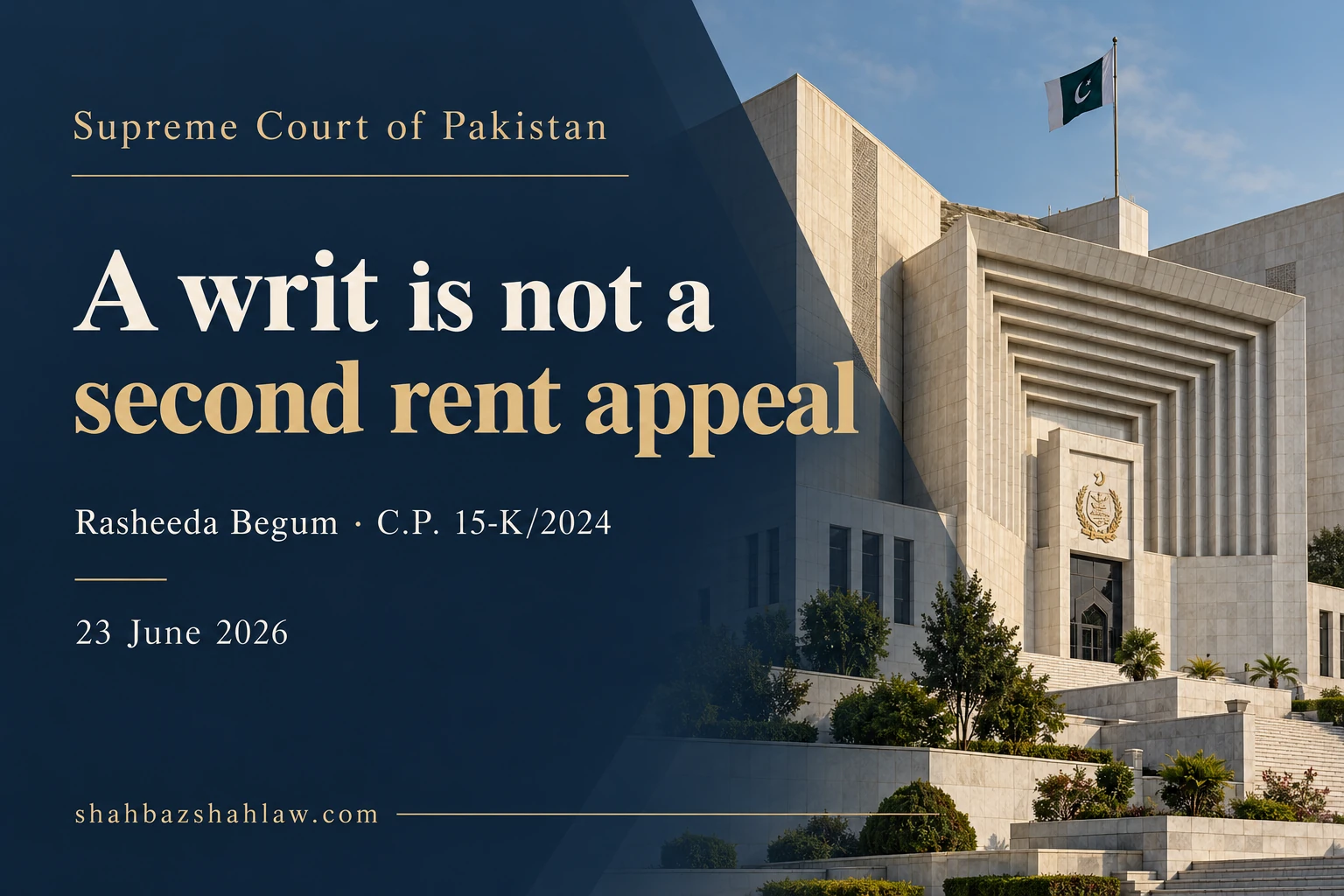
Article 199 does not create a second rent appeal
The Supreme Court of Pakistan has set aside a Sindh High Court judgment in a long-running landlord–government dispute, holding that writ jurisdiction cannot be used as a second appeal to replace supported findings of the rent courts. The case was remanded to the High Court for fresh adjudication, preferably within six months of receiving the Supreme Court judgment. Judgment, paragraphs 6–8 and 13.
The judgment in Mst. Rasheeda Begum through L.Rs. concerns both the boundaries of Article 199 review and the treatment of a tenant’s belated challenge to the landlord’s title. The Court found that material registered sale deeds had escaped the High Court’s attention and that an oral assertion about an old auction cancellation could not, on this record, simply defeat the tenancy relationship in ejectment proceedings. Judgment, paragraphs 10–12.
How a rent dispute became a title dispute
The petitioner purchased a 1,000-square-yard property through two registered sale deeds, covering 210 and 790 square yards respectively, registered on 28 March 2011. The Sindh Government had already occupied the property as a tenant and paid rent to the previous owner under a tenancy agreement recording Rs 50,000 per month. Following the purchase, the petitioner served notice under section 18 of the Sindh Rented Premises Ordinance, 1979. Judgment, paragraphs 2–3.
The litigation then passed through repeated rounds before the Rent Controller, appellate court and High Court. In the later proceedings, the Government raised an exemption objection under section 3, asserting that the property had been requisitioned. The Rent Controller rejected that objection. A tentative rent order under section 16(1) was followed by striking off the Government’s defence under section 16(2) after non-deposit of arrears. The rent appeals failed. Judgment, paragraph 3.
The Government then succeeded before the High Court in Constitutional Petition No. S-1114/2022. The High Court set aside the concurrent findings and required the landlord to seek a declaration of title through a civil suit. That was the decision challenged in Civil Petition No. 15-K of 2024. Judgment, paragraphs 1 and 3.
When a High Court may interfere with concurrent findings
The Supreme Court did not make concurrent findings immune from review. It identified recognised defects capable of justifying intervention: gross misreading or non-reading of evidence, perverse or speculative findings, jurisdictional failure, application of an incorrect legal provision, serious prejudice and violation of an express statutory provision or constitutional right. Judgment, paragraph 6.
The distinction lies in the court’s task. Constitutional review examines whether the lower forum acted lawfully within its authority. An appeal can involve a fuller reconsideration of both facts and law. Article 199 does not permit a second factual appeal merely because the High Court considers another view of the evidence possible. Judgment, paragraphs 7–8.
A successful writ challenge must therefore identify a legally significant defect in the decision-making process or resulting findings. Simply repeating arguments already rejected by the rent forums does not supply that defect. This is the practical consequence of the test set out by the Court. Judgment, paragraphs 6–8.
Why the two sale deeds mattered
The petitioner argued that the High Court considered only the deed covering 210 square yards and overlooked the second deed for 790 square yards. Both had been exhibited before the Rent Controller and formed part of the record called by the High Court. The Supreme Court found that the sale deeds had escaped the High Court’s attention when it upset the concurrent findings. Judgment, paragraphs 4–5 and 10.
That omission mattered because the apparent gap in title documentation helped turn the rent dispute into a direction for a separate civil suit. A court cannot properly assess the need for such a course while overlooking material documents already in the record. Judgment, paragraphs 4 and 10–11.
The Supreme Court did not use this conclusion to issue a final declaration of ownership. It required reconsideration by the High Court, with independent application of mind to the record and the jurisdictional limits governing rent proceedings. Judgment, paragraph 13.
The belated assertion that the auction was cancelled
The Government argued that the original purchaser’s auction had been cancelled in 1974. The Court noted that this plea had not been raised in the earlier rounds of litigation, despite the Government having recognised the previous landlord and paid rent. Merely making an oral allegation about cancellation was insufficient to defy the landlord–tenant relationship in the ejectment proceedings. Judgment, paragraphs 5 and 10–11.
The Court also questioned why the landlord alone should have to seek a civil declaration when the Government claimed a competing right. The rent forum was not the forum for finally deciding ownership. A complicated title controversy could not simply be resolved in writ jurisdiction either. Judgment, paragraphs 10–11.
This reasoning is tied to the procedural history and the evidence. It does not establish that every title objection by a tenant is legally irrelevant. It explains why the particular belated assertion, earlier acceptance of the tenancy and overlooked documents required a different judicial approach. Judgment, paragraphs 10–13.
Government occupation did not prove the claimed exemption
The Government’s reliance on section 3 also required proof of the legal basis for the exemption it asserted. The Supreme Court discussed the exclusion relating to premises owned or requisitioned under law by or on behalf of government, and the notification mechanism in section 3(2). It observed that any such notification should have been produced before the Rent Controller rather than the Government acquiescing in the tenancy relationship and changing its position later. Judgment, paragraphs 11–12.
The important distinction is between occupying premises as a tenant and establishing that premises fall within a statutory exclusion. A government department’s presence alone did not establish the claimed exemption on this record. The Court’s reasoning should not be expanded into an assertion that every government tenancy is always covered, or that every exclusion necessarily depends on the same instrument regardless of its statutory basis. Judgment, paragraphs 11–12.
The Court referred to the doctrine of approbation and reprobation when addressing the Government’s inconsistent positions. Its concern was the attempt to accept the tenancy relationship and later disown it in the circumstances of this litigation. Judgment, paragraph 12.
What the Supreme Court actually ordered
The petition was converted into an appeal and allowed. The Sindh High Court judgment of 5 December 2023 was set aside, and the case returned to that Court for a fresh decision, preferably within six months from receipt of the judgment. Justice Muhammad Ali Mazhar wrote for a bench also comprising Justices Irfan Saadat Khan and Aqeel Ahmed Abbasi. The judgment is dated 23 June 2026. Judgment, opening page and paragraph 13.
The outcome should be described precisely. The Supreme Court did not itself finally declare title, fix the recoverable arrears or issue a fresh final eviction order. The operative relief was remand for reconsideration of the rent-law and writ-jurisdiction issues identified in the judgment. Judgment, paragraph 13.
For a separate discussion of subsequent rent default, advance payments and material impairment, see our analysis of the Sindh rent eviction appeals. Those questions must be kept distinct from the limits of writ review addressed here.
Sources
- Supreme Court judgment and PDF download: Mst. Rasheeda Begum through L.Rs. v. The Province of Sindh through Secretary Education & Literacy Department and others, Civil Petition No. 15-K of 2024, decided 2026-06-23.
- Full case details and judgment summary.
- Supreme Court official judgment register. Locate the case using its number and decision date.
Authorities discussed above are identified as applied or cited in this judgment.
Frequently asked questions
Can Article 199 be used as a second appeal in a rent dispute?
No. The judgment distinguishes judicial review from a fresh appeal on facts. A recognised legal or jurisdictional defect may justify intervention. Read the judgment.
Are concurrent rent findings completely immune from review?
No. Material misreading or non-reading, perversity, jurisdictional error and other serious legal defects identified by the Court may justify interference. Read the judgment.
Did the Supreme Court finally order eviction or decide ownership?
No. It set aside the High Court judgment and remanded the matter for fresh adjudication. Read the judgment.
Did government occupation itself establish exemption from the rent law?
No. On this record, the claimed statutory exclusion needed a proper legal and evidential foundation; the Court discussed section 3 and the failure to produce the relevant notification. Read the judgment.
What time did the Supreme Court give for the fresh decision?
The High Court was asked to decide the matter preferably within six months from receipt of the Supreme Court judgment. Read the judgment.
Legal issues in this decision
Browse connected case law
New judgment alerts
Follow this court or legal topic
Receive new judgments and analysis about Supreme Court of Pakistan, Civil Law, Constitutional Law by email.
Primary-source materials
Verify the underlying law and record
Court documents, statutory provisions, official notifications, government documents, and external official sources relied on or relevant to this article.
Mst. Rasheeda Begum through L.Rs. v. The Province of Sindh through Secretary Education & Literacy Department and others
rent-writ-not-second-appeal-rasheeda-begum-supreme-court.pdf · PDF · 29 KB
Supreme Court official judgment register
Research integrity
Editorial and source record
- Author
- Shahbaz Shah, Advocate High Court
- Legal review
- Author-reviewed
- Sources checked
- October 26, 2026
- Primary materials
- 2 recorded on this page
- Corrections
- No material correction note is recorded.
Independent legal journal
Written and published by Shahbaz Shah
This article forms part of an independent journal focused on practical analysis of Pakistani law, courts, and legal institutions.
About the authorReader feedback
Was this analysis useful?
Choose one response and, if you wish, tell us what should be improved. No name or email is required. See the Privacy Policy.