Share this article
For more judgments and legal updates, follow our WhatsApp channel.
Independently written and published by Shahbaz Shah Legal Journal.
Case reference
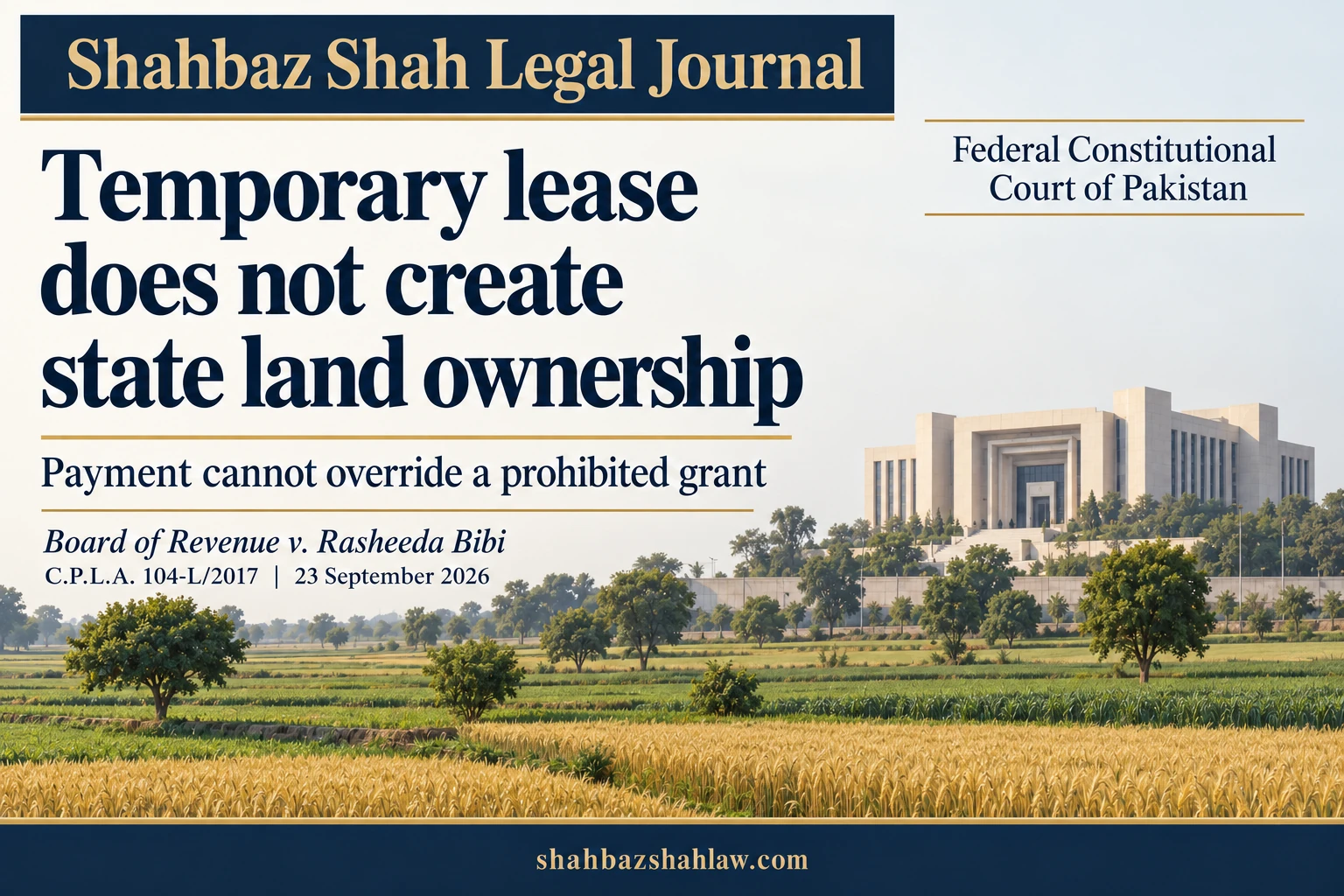
Board of Revenue v. Rasheeda Bibi
- Case
- C.P.L.A. 104-L/2017
- Court / date
- FCC · 23 September 2026
A temporary lease could not defeat the ban on granting the land
The Federal Constitutional Court of Pakistan has rejected a claim to proprietary rights over agricultural state land in Pakpattan, holding that a temporary cultivation lease does not create a vested right to ownership. Where the governing policy excludes the land from grant, prolonged possession, lease extensions or payment of government dues cannot remove that prohibition. Judgment, paragraphs 5–8, 12 and 18–19.
The judgment in Member (Colonies), Board of Revenue v. Rasheeda Bibi also clarifies section 163 of the Punjab Land Revenue Act, 1967. A competent successor revenue officer may review a predecessor’s order after meeting the statutory requirements, including the required prior sanction. Giving that sanction does not mean the Board has itself decided the review. Judgment, paragraphs 10–11 and 14–15.
The written judgment is dated 23 September 2026. The FCC’s official judgment register lists its upload on 26 October 2026. The newly uploaded reasons explain why the Court set aside the Lahore High Court decision and finally rejected the ownership claim, rather than sending the dispute back for another round of proceedings. Judgment, paragraphs 17–19 and page 10.
The Pakpattan land and the disputed grant
The dispute concerned 49 acres, 5 kanals and 13 marlas in Chak No. 2/KB, Tehsil Pakpattan. The case arose from cultivation under the Temporary Cultivation Lease Scheme, described in the judgment’s background as running from Kharif 1968 to Rabi 1978, with extensions under government policy. The respondents later sought proprietary rights under a notification dated 3 September 1979. Judgment, paragraph 2.
Their application was rejected on 14 May 2001 because the land fell within a prohibited zone. An appeal failed on 11 December 2001. After a remand by the Member, Board of Revenue on 28 February 2004, the EDO (Revenue), Pakpattan accepted the claim on 28 October 2008 and directed issuance of a challan for payment of the land price. Judgment, paragraph 2.
That favourable administrative step became the focus of further proceedings. The EDO sought permission to review the predecessor’s 2008 order. On 24 August 2011, the Member, Board of Revenue permitted review and dismissed the respondents’ application opposing that reference and seeking execution of a sale deed. The distinction between permission to review and an actual decision on review later became decisive. Judgment, paragraphs 10 and 15–17.
On 28 October 2016, the Lahore High Court allowed the respondents’ writ petition. The Board of Revenue side challenged that judgment through C.P.L.A. No. 104-L of 2017. Originally filed in the Supreme Court, the matter was transferred to the FCC under the constitutional transition described in the judgment. Judgment, paragraphs 1–2.
Cultivation and ownership are different legal rights
The Court’s starting point was the nature of the original permission. A temporary cultivation lease allows the holder to possess and cultivate land without displacing the State’s ownership. A permanent grant of proprietary rights is a different transaction: it transfers public property and must be authorised by the governing law and policy. Judgment, paragraphs 5–6.
The existence of a valid temporary lease therefore does not answer whether the same land is eligible for permanent transfer. A person seeking ownership must satisfy the conditions of the instrument under which that ownership is claimed. An official cannot confer a proprietary interest that the policy places beyond the official’s authority to grant. Judgment, paragraphs 5–6.
Here, the prohibition concerned the land’s eligibility itself. Once the relevant record established that the land belonged to an excluded category, the ownership claim lacked the necessary legal foundation. The Court treated this as a substantive limit on power, rather than a minor defect in processing the application. Judgment, paragraphs 7–8.
The ruling is consequently more precise than a general objection to long occupation. It concerns an attempt to obtain ownership under a particular grant policy despite an exclusion under that policy. A temporary lease, however old, could not supply the authority to make the prohibited grant. Judgment, paragraphs 5–8 and 18.
A challan or payment is not a conveyance of title
The 2008 direction to issue a challan did not, by itself, confer ownership or an unconditional right to demand transfer. It was an intermediate step towards a proposed grant, dependent on satisfaction of all substantive policy conditions. Until a competent authority lawfully conferred proprietary rights, the title remained with the State. Judgment, paragraph 12.
The same reasoning applied to payment or acceptance of the prescribed amount. Such conduct could not cure the absence of a foundational eligibility condition. If the land was excluded from grant because it fell within the prohibited zone, government acceptance of money could not make the transfer lawful. Judgment, paragraphs 7 and 12.
This separates two questions which can otherwise become confused: whether an applicant complied with a payment demand, and whether the authority had legal power to grant the land at all. Compliance with the first could not overcome a negative answer to the second. Judgment, paragraphs 8 and 12.
The judgment decides the proprietary-rights claim. It does not set out a separate refund award or compensation direction, and it should not be presented as deciding those remedies. Judgment, paragraph 19.
Courts must confront an established prohibition in the record
The FCC also explained why the dispute could not be resolved solely through arguments about pleadings. State property is held by public functionaries in trust for the community. An established legal impediment apparent from the official record cannot be ignored merely because a party has not raised a particular plea. Judgment, paragraph 9.
The Court recognised the importance of pleadings to procedural fairness, but held that they cannot be used to sustain an unauthorised transfer of public property. It cited Al-Shafique Housing Society v. P.M.A., PLD 1992 SC 113; Provincial Government v. Shabbir Hussain, PLD 2005 SC 337; and Abdul Haq Indher v. Province of Sindh, 2007 SCMR 907, in that discussion. These authorities are identified here as cited in the FCC judgment. Judgment, paragraph 9 and its footnotes.
The required inquiry was therefore tied to the relevant policy and evidence: what did the 1979 notification permit, at what legally relevant time did the land’s status fall to be assessed, and what did the contemporary official record establish? The judgment does not specify a universal prohibited-zone distance or boundary applicable to every state-land scheme. Judgment, paragraphs 13 and 16.
Section 163: permission to review is different from deciding the review
On the procedural issue, the FCC held that section 163 permits a competent revenue officer to review an order made by that officer or a predecessor, subject to the statutory conditions. The mere fact that the order came from a predecessor did not make review unlawful. Judgment, paragraph 10.
In this case, the Court accepted the Board of Revenue’s prior sanction as the condition enabling the successor EDO (Revenue) to proceed. The sanction did not transfer the merits of the review to the Board, or convert the permission order into an appellate or revisional decision. The competent revenue officer remained responsible for deciding the review in accordance with law. Judgment, paragraphs 10 and 14.
The Lahore High Court had treated the Member, Board of Revenue as having assumed and exercised review jurisdiction. The FCC found that reading inconsistent with the record: the Member had agreed with the EDO’s recommendations and allowed the successor officer to review the earlier order. Judgment, paragraph 15.
This is a reason to read the operative part of a revenue order carefully. A challenge to the authority granting sanction and a challenge to the officer deciding the review concern different acts and may raise different legal questions. Judgment, paragraphs 10 and 14–15.
The safeguards and limitation distinction still matter
Section 163, as reproduced and applied by the Court, contains conditions beyond prior sanction. These include reasonable notice before an order is modified or reversed, and a bar on review of an order against which an appeal has been preferred. The permission to review is not a general exemption from those safeguards. Judgment, paragraph 10.
The Court also distinguished an application made by an aggrieved person from suo motu review initiated by the revenue officer. A party’s application is subject to the prescribed limitation and conditions. The Court rejected mechanically applying that application-based limitation to a statutory own-motion power in the absence of an express provision requiring it. Judgment, paragraph 11.
That distinction should not be turned into a claim that any officer can reopen any order, at any time, without notice or legal justification. The judgment preserves the officer’s statutory competence and the conditions applicable to the actual form of review being exercised. Judgment, paragraphs 10–11 and 18.
Why the FCC finally rejected the claim instead of remanding it
Although the judgment discusses matters the High Court should have examined, its final order was not a remand. The FCC referred to the prolonged litigation and relied on revenue findings that the respondents had failed to qualify for proprietary rights: the land lay in the prohibited zone, they had not been in cultivating possession since Rabi 1977, and they were not the original allottees but claimed through sub-tenancy. Judgment, paragraph 17.
Those specific findings are important alongside the earlier lease history. The Court held that findings left unchallenged before the appropriate revenue forum bound the respondents in the circumstances before it. It considered another return to the revenue hierarchy futile and decided the matter after hearing both sides. Judgment, paragraph 17.
The petition was converted into an appeal and allowed. The FCC set aside the Lahore High Court judgment, restored and maintained the Board’s order of 24 August 2011 in principle, declared the EDO’s 28 October 2008 order unsustainable, and held that the respondents had no entitlement to proprietary rights. Each side was left to bear its own costs. Judgment, paragraph 19.
For a person claiming state land, the practical issue is eligibility under the policy before reliance on possession, payment or an earlier favourable step. For counsel challenging a revenue review, the separate issues are the officer’s competence, the required sanction, notice, limitation and the actual effect of the order challenged. Both parts of the case must be addressed. Judgment, paragraphs 10–18.
For a separate FCC decision concerning a summary alteration of settlement records, see our analysis of Muhammad Ashraf Rana and section 166. Its clerical-correction issue should be kept distinct from the statutory review and prohibited-grant issues decided here.
Sources
- Full FCC judgment and PDF download: C.P.L.A. No. 104-L of 2017, dated 23 September 2026.
- Official FCC judgment PDF.
- FCC official judgment register: upload listed as 26 October 2026; approved for reporting.
- Complete case details and judgment summary.
Frequently asked questions
Does a temporary cultivation lease make the lessee an owner?
No. A temporary cultivation lease permits possession and cultivation while ownership remains with the State. Proprietary rights require a lawful grant satisfying the governing policy. Read the judgment.
Can payment of the price remove a prohibition on granting the land?
No. The FCC held that payment or acceptance of government dues cannot cure the absence of eligibility or override a substantive prohibition on the grant. Read the judgment.
Can a successor revenue officer review a predecessor’s order?
Section 163 permits this where the officer has statutory competence and meets the prescribed conditions. In this case, the Court held that the required prior sanction enabled the EDO (Revenue) to undertake review. Read the judgment.
Does permission from the Board of Revenue itself decide the review?
No. The permission enables the competent officer to exercise review jurisdiction. It is not itself an appellate, revisional or substantive decision on the merits of that review. Read the judgment.
Does the 90-day period apply automatically to suo motu review?
No. The Court distinguished a party’s review application from review on the officer’s own motion. It rejected mechanically applying the party-application limitation to suo motu review, while preserving the statutory conditions governing its exercise. Read the judgment.
Did the FCC send the case back to the revenue authorities?
No. It allowed the appeal, set aside the Lahore High Court judgment, restored the Board’s order in principle and declared the 2008 EDO order unsustainable and the respondents ineligible for proprietary rights. Read the judgment.
Was the judgment decided on 26 October 2026?
The judgment records 23 September 2026 as its date. The FCC’s official register lists its upload on 26 October 2026. The decision date and upload date are different. Read the judgment.
New judgment alerts
Follow this court or legal topic
Receive new judgments and analysis about Federal Constitutional Court of Pakistan, Civil Law, Constitutional Law by email.
Primary-source materials
Verify the underlying law and record
Court documents, statutory provisions, official notifications, government documents, and external official sources relied on or relevant to this article.
Member (Colonies), Board of Revenue, Punjab, Lahore and others v. Rasheeda Bibi (deceased), widow of Ghulam Sarwar (deceased), through legal heirs and others
temporary-cultivation-lease-state-land-ownership-rasheeda-bibi-fcc.pdf · PDF · 238 KB
Federal Constitutional Court — official judgment PDF
Federal Constitutional Court — official judgment register
Research integrity
Editorial and source record
- Author
- Shahbaz Shah, Advocate High Court
- Legal review
- Author-reviewed
- Sources checked
- October 27, 2026
- Primary materials
- 3 recorded on this page
- Corrections
- No material correction note is recorded.
Independent legal journal
Written and published by Shahbaz Shah
This article forms part of an independent journal focused on practical analysis of Pakistani law, courts, and legal institutions.
About the authorReader feedback
Was this analysis useful?
Choose one response and, if you wish, tell us what should be improved. No name or email is required. See the Privacy Policy.