Share this article
For more judgments and legal updates, follow our WhatsApp channel.
Independently written and published by Shahbaz Shah Legal Journal.
Case reference
Arun @ Deepak v. State of U.P.
- Reference
- 2026 INSC 1150 · SLP (Crl.) 4859/2026
- Court / date
- Supreme Court of India · 26 October 2026
Six lost years and a prosecution without proof
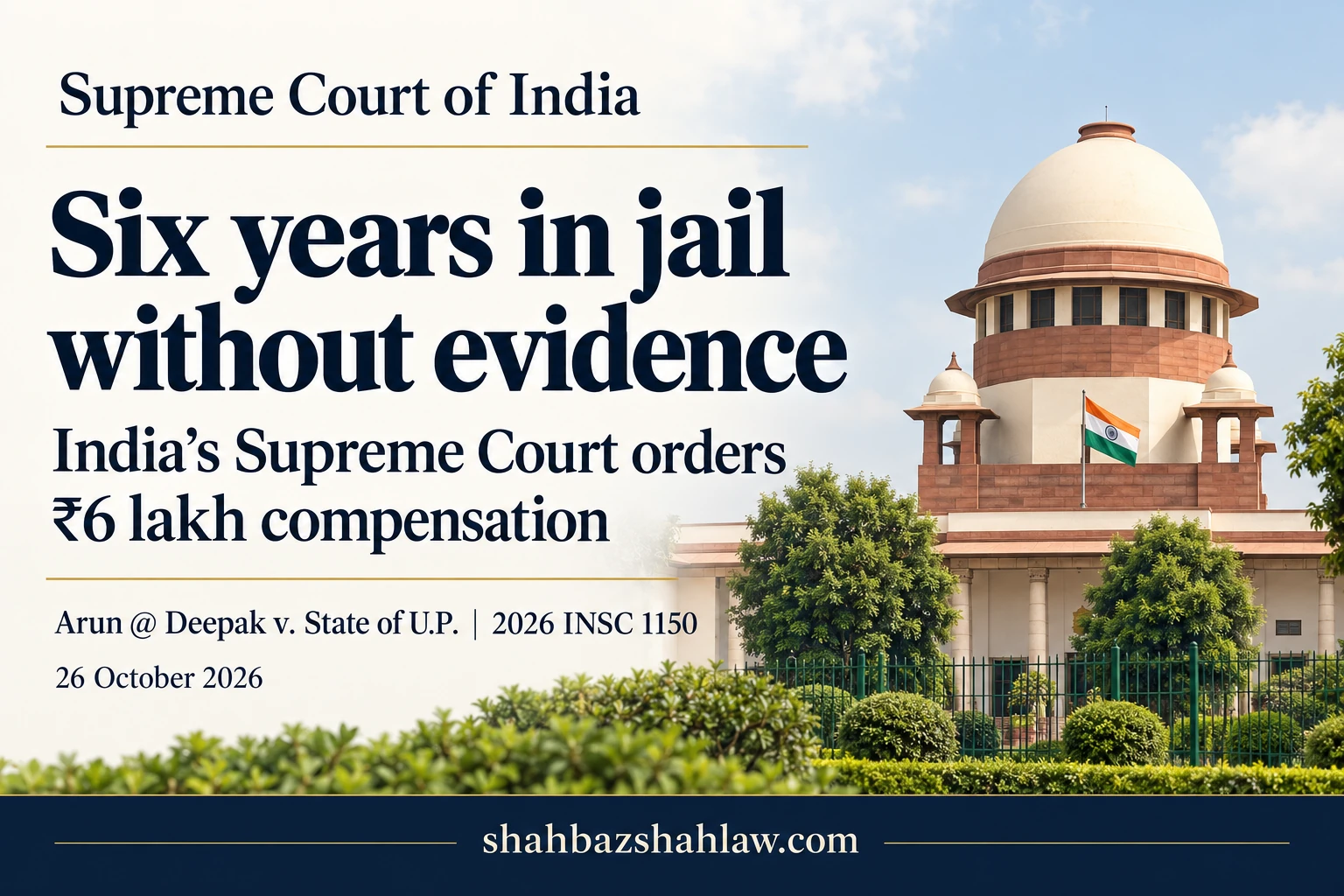
The Supreme Court of India has directed Uttar Pradesh to pay ₹6 lakh to Arun @ Deepak after he spent six years in custody as an undertrial in a kidnapping and murder case. The trial ended in acquittal. When the Supreme Court examined the record, it found an investigation and prosecution that had failed to establish even the basic links connecting him with the alleged crime. Judgment, paragraphs 14–16.
The money must be paid within one month. If the State misses that deadline, the amount will carry interest at 18% per year. The Court also directed that its judgment be sent to the State’s Director General of Police and Home Secretary, and urged proper training in investigation. Judgment, paragraphs 14 and 16.
The procedural setting matters. This was originally a bail petition, not an appeal in which the Supreme Court itself acquitted Arun. The trial court acquitted him after the Supreme Court directed an expedited trial. The Supreme Court then examined that judgment and ordered compensation for the failures disclosed by the record. Judgment, paragraphs 1–3 and 14–17.
How a missing-person case became a murder prosecution
The case began after a man failed to return home from work at Kiraoli Tehsil in October 2019. His father first reported him missing, then reported information suggesting an abduction by unknown persons. Police later arrested Arun and Lalit Kishore on the basis of CCTV material and a co-accused’s confession. Arun was not named in the FIR or in the initial statement discussed by the Court. Judgment, paragraphs 1–5.
The father later testified that the two men and Lalit Kishore’s mother had demanded ₹50 lakh in ransom and threatened to kill his son. That alleged visit was central to the prosecution’s account, but the father had never reported the demand to the police. It appeared for the first time in his evidence in court. Judgment, paragraphs 5 and 11.
Police recovered a motorcycle and a bundle of charred bones near a drain. Other belongings were recovered from or near the co-accused’s house. Lalit Kishore died and his mother remained absconding; Arun alone faced the trial. Only six prosecution witnesses were examined. Judgment, paragraphs 3, 6 and 10.
The bones were never identified as the missing man’s
The medical evidence exposed a fundamental gap. The doctor could not establish the time or cause of death from the recovered bones. Although the bones were sent for forensic examination, no result identifying them as the missing person’s remains was produced at trial. The father’s DNA was not taken for comparison. Judgment, paragraphs 7 and 13.
That failure mattered independently of the other defects. The prosecution was asking the court to accept a murder narrative without proving that the remains belonged to the man said to have been killed. The Supreme Court also found no medical support for the investigating officer’s account that sleeping pills and a taped mouth had caused suffocation. Judgment, paragraphs 9 and 13.
The alleged destruction of the body was similarly unsupported. Police did not identify the place where it was supposedly burnt for forensic examination. They did not establish the alleged purchase of 55 litres of petrol, identify the petrol pump, or chemically test the cans. Judgment, paragraph 9.
CCTV and call records did not supply the missing links
The prosecution relied on CCTV footage and call-detail records, but neither was proved with the supporting certificate under section 65B of the Indian Evidence Act, 1872. The footage was also unclear, making identification of the persons on the motorcycle difficult. Investigators did not identify the subscribers of the SIM cards covered by the call records. Judgment, paragraphs 8 and 12–13.
The problem was therefore wider than a missing document. The prosecution had not reliably identified the people in the footage or established what the telephone material proved about the accused. The Court found that the supposed last-seen circumstance had not been effectively established. Judgment, paragraphs 8 and 12.
Even the recovered motorcycle was not produced during trial, put to the witnesses, or linked to the missing person by proof of ownership. Each omitted step weakened a chain that the prosecution needed to establish through admissible evidence. Judgment, paragraph 13.
A recovery must be linked to a proved disclosure
The Supreme Court also examined the supposed discovery evidence. No statement about concealment was shown to have been recorded from the accused before the recoveries. The witnesses and investigating officer did not establish that it was the accused who led them to the relevant places. The father’s own account was that the police led the party there. Judgment, paragraph 13.
These findings explain the Court’s reference to section 27 of the Indian Evidence Act. A seizure cannot simply be described as a discovery at an accused person’s instance without proving the information and the connection that make that description legally meaningful. Here, the recoveries were principally from the deceased co-accused’s house, not Arun’s. Judgment, paragraphs 6 and 13.
The police confession could not fill the gap. The Court rejected reliance on a confession made to police and found none of the four circumstances projected by the prosecution proved. Judgment, paragraphs 10–12.
Why the Court ordered compensation
The judgment treats the accused as a person whom the justice system also has a duty to protect. Investigation and prosecution exist to secure justice, including justice for the accused; their purpose is not to obtain a conviction by any means. The Court found the failings in this case sufficiently blatant to require financial reparation. Judgment, paragraphs 14–16.
The award should be read with those findings. The Court did not create a fixed ₹6 lakh tariff for every acquittal, nor did it hold that every unsuccessful prosecution automatically requires compensation. It ordered payment for the extraordinary failures and six years of detention established in Arun’s case. Judgment, paragraphs 14–16.
For lawyers, the practical lesson is to examine the prosecution’s actual chain: identification, forensic results, proof of electronic material, the disclosure preceding a recovery, and steps taken to bring the trial to a timely conclusion. In this record, the labels attached to the evidence could not replace proof. Judgment, paragraphs 7–15.
This decision applies Indian evidence law. Readers considering a Pakistani case should examine the governing Pakistani provisions separately. For another Indian decision on prolonged custody, see our analysis of Liakat Ali and delayed trial.
Sources
- Arun @ Deepak v. State of U.P. — 2026 INSC 1150, Supreme Court of India, 26 October 2026.
- Official Supreme Court judgment record.
- Supreme Court of India judgment search.
Frequently asked questions
Did the Supreme Court acquit Arun?
No. The trial court acquitted him after the Supreme Court directed completion of the trial. The Supreme Court subsequently examined the record and ordered compensation.
How much compensation must Uttar Pradesh pay?
₹6 lakh within one month. If payment is delayed beyond that period, the amount carries interest at 18% per annum.
Was the CCTV evidence sufficient?
No. The footage was unclear and was not proved with a section 65B certificate. The call-detail records were also unsupported by the required certificate.
Were the recovered bones identified?
No identifying forensic result was produced, and the father’s DNA was not taken for comparison. The doctor could not establish the time or cause of death.
Does every acquittal automatically justify compensation?
This judgment does not establish that rule. Its compensation order rests on the exceptionally serious failures and six years of undertrial detention found in this case.
New judgment alerts
Follow this court or legal topic
Receive new judgments and analysis about Supreme Court of India, Criminal Law, Evidence by email.
Primary-source materials
Verify the underlying law and record
Court documents, statutory provisions, official notifications, government documents, and external official sources relied on or relevant to this article.
Arun @ Deepak v. State of U.P.
arun-deepak-six-years-detention-compensation-supreme-court-india.pdf · PDF · 203 KB
Arun @ Deepak v. State of U.P. — complete judgment
Supreme Court of India — official judgment record
Supreme Court of India — judgment search
Research integrity
Editorial and source record
- Author
- Shahbaz Shah, Advocate High Court
- Legal review
- Author-reviewed
- Sources checked
- October 26, 2026
- Primary materials
- 4 recorded on this page
- Corrections
- No material correction note is recorded.
Independent legal journal
Written and published by Shahbaz Shah
This article forms part of an independent journal focused on practical analysis of Pakistani law, courts, and legal institutions.
About the authorReader feedback
Was this analysis useful?
Choose one response and, if you wish, tell us what should be improved. No name or email is required. See the Privacy Policy.