Share this article
For more judgments and legal updates, follow our WhatsApp channel.
Independently written and published by Shahbaz Shah Legal Journal.
Case reference
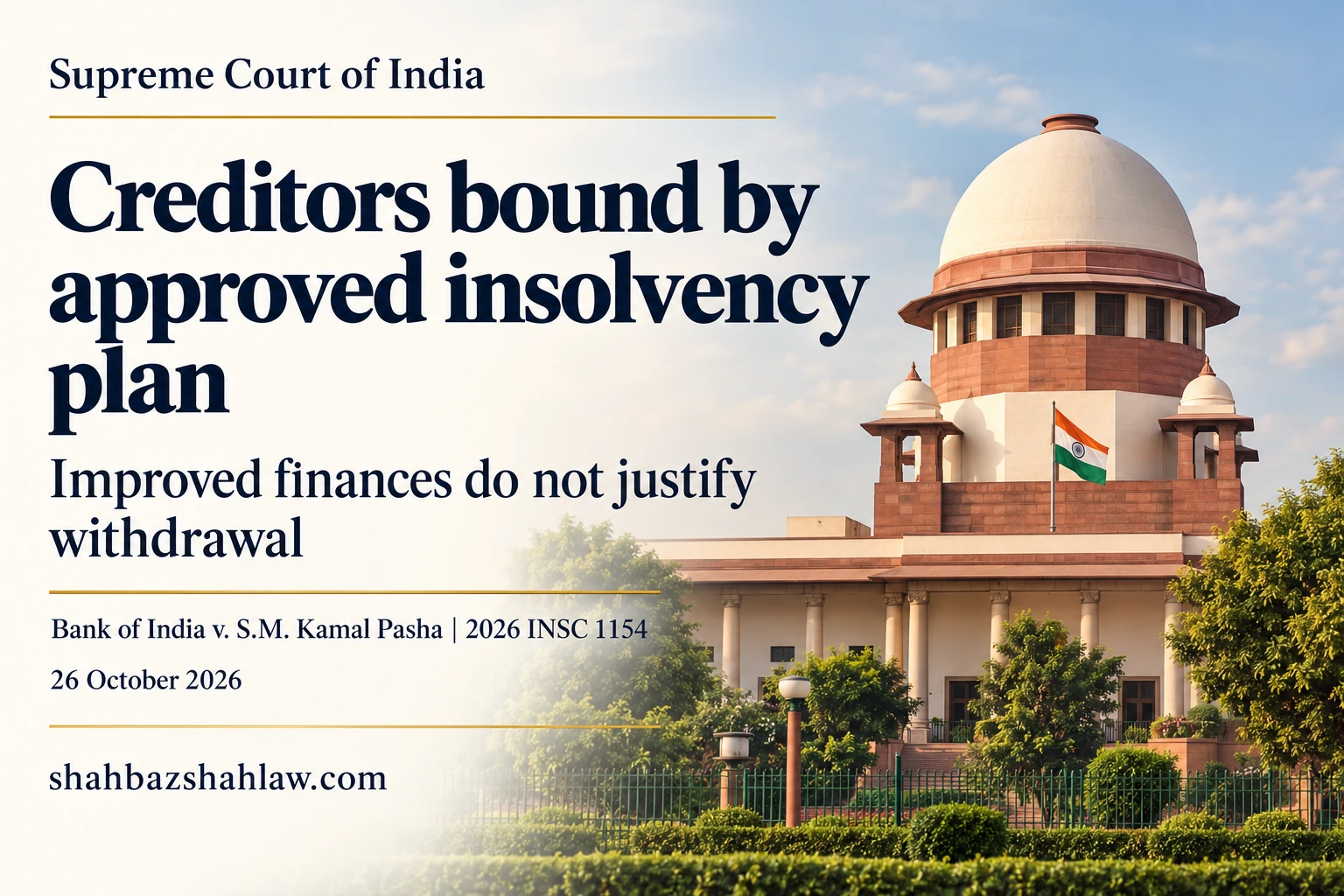
Bank of India v. S.M. Kamal Pasha
- Reference
- 2026 INSC 1154 · C.A. 12045/2026
- Court / date
- Supreme Court of India · 26 October 2026
A financial recovery does not release creditors from an approved plan
The Supreme Court of India has held that creditors cannot withdraw their approval of an insolvency resolution plan merely because the corporate debtor’s finances improved while the plan awaited the National Company Law Tribunal’s decision. Once approved by the Committee of Creditors, the plan binds both that committee and the successful resolution applicant at the stage considered in this case. Judgment, paragraphs 9–18 and 25.
The ruling in Bank of India v. S.M. Kamal Pasha applies the binding effect recognised in Ebix Singapore to creditors as well as the successful bidder. The opportunity to obtain a better financial outcome after delay does not, by itself, supply a legal power to abandon the approved arrangement. Judgment, paragraphs 10–14 and 24–25.
The Court did not itself approve the resolution plan. It left the pending applications to the NCLT and requested an expeditious joint decision, with compliance under sections 30(2) and 31(1) of the Insolvency and Bankruptcy Code, 2016 remaining essential. Judgment, paragraphs 25–27.
Why the creditors wanted to start again
The corporate debtor’s toll-collection business had been affected by the Covid-19 pandemic. According to the creditors’ submissions, the approved plan involved a resolution amount of ₹172.55 crore when the company’s opening balance was ₹30 crore. During the intervening years, that balance rose to ₹165 crore. They argued that implementation would now give the successful applicant a windfall and leave creditors accepting an unnecessary haircut. Judgment, paragraph 5.
The Committee of Creditors unanimously supported withdrawing its approval and issuing a fresh invitation for expressions of interest. The company’s holding company favoured a different route: a one-time settlement and an end to the insolvency process itself. The successful resolution applicant opposed both proposals. Judgment, paragraphs 1–4 and 7.
The bidder argued that recovery in the company’s finances was already contemplated in the plan. Had implementation occurred on time, the operating income would have benefited the bidder. It maintained that creditors could no more escape an accepted plan because the business improved than the bidder could escape because it deteriorated. Judgment, paragraph 6.
These were competing submissions. The Supreme Court’s central legal finding concerned the plan’s binding effect; it preserved the NCLT’s role in deciding the applications still before it. Judgment, paragraph 25.
CoC approval and NCLT approval perform different functions
The case arose in the interval between CoC approval and NCLT confirmation. That interval is important because the creditors argued as though the plan remained open to withdrawal until the Tribunal approved it. The Supreme Court rejected that understanding of the insolvency framework. Judgment, paragraphs 9–10 and 14.
Drawing on Ebix Singapore (P) Ltd. v. Committee of Creditors of Educomp Solutions Ltd., (2022) 2 SCC 401, the Court explained that a resolution plan is not merely an ordinary private contract. Its binding effects come from the IBC framework, including the voting mechanism and the treatment of dissenting stakeholders. Judgment, paragraphs 9–11.
That does not make NCLT scrutiny redundant. The Tribunal must still determine whether the plan meets the statutory requirements. The distinction is between the parties’ ability to withdraw their commitment and the Tribunal’s obligation to examine the plan before granting approval. Judgment, paragraphs 13 and 17–18.
Section 12A cannot be read in isolation
Section 12A and Regulation 30A provide a route for withdrawal of insolvency applications in the circumstances discussed by the Court. The judgment examined the stages at which that route operates and rejected the suggestion that the statutory text can be read without the rest of the Code. Judgment, paragraphs 15–17.
Reading sections 30 and 31 together, the Court concluded that once the CoC has approved the plan and placed it before the adjudicating authority, neither the underlying application nor the approved plan can be withdrawn in the manner sought. The approval process must then proceed within the statutory framework. Judgment, paragraphs 17–18.
The unanimity of the creditors did not change that result. A high voting percentage may establish what creditors want; it does not create a power the legal framework withholds at that stage. Judgment, paragraphs 14–18 and 24–25.
Continuing commercial judgment has limits
The creditors also relied on Kalyani Transco v. Bhushan Power & Steel Ltd., (2026) 6 SCC 431, to argue that the CoC continues to exist through implementation. The Supreme Court accepted the distinction between continued existence and a power to undo the plan. Judgment, paragraphs 21–22.
As the judgment explains, the CoC may continue to deal with matters affecting implementation, but that continuing role does not permit decisions that alter the resolution plan already submitted to the adjudicating authority. The earlier decision therefore did not give the creditors the withdrawal power claimed here. Judgment, paragraphs 21–22.
Commercial wisdom remains significant in insolvency proceedings. It operates within the Code, however, and cannot by itself turn a concluded approval into a standing option to restart bidding whenever later circumstances appear more attractive. Judgment, paragraphs 13–14 and 24–25.
What the NCLT must still decide
The NCLAT had rejected the creditors’ withdrawal request, revived the plan-approval application and directed consideration of the holding company’s application as well. The Supreme Court declined to interfere with that arrangement. It requested that both applications be decided together and without further avoidable delay. Judgment, paragraphs 3 and 25–27.
The NCLT must examine the company’s current financial position and cash balance against the terms of the plan while applying the statutory requirements. Improved profitability alone cannot justify refusing approval if the plan satisfies section 30(2). Judgment, paragraph 25.
The judgment contains an express limit on its observations. Apart from the binding nature of the plan as between the CoC and successful applicant, the Court described its other observations as prima facie and not controlling the NCLT’s final adjudication. An account of this case must therefore distinguish the settled legal point from the merits still awaiting decision. Judgment, paragraph 25.
Why the ruling matters
For a successful bidder, the decision supports certainty after creditors accept a plan. For creditors, it requires close attention to financial assumptions and proposed terms before approval. Both sides remain subject to the IBC framework rather than a general freedom to renegotiate after the commercial position changes. Judgment, paragraphs 9–14 and 25.
The case does not excuse an applicant’s failure to implement an approved plan, decide every pending settlement proposal, or remove the NCLT’s statutory scrutiny. Its central point is reciprocal commitment at the stage reached in these proceedings. Judgment, paragraphs 23–26.
For separate Indian insolvency coverage concerning the use of unreliable authorities in litigation, see our Deepak Raheja analysis. This judgment concerns India’s IBC and does not determine Pakistani corporate insolvency procedure.
Sources
- Bank of India & others v. S.M. Kamal Pasha & others — 2026 INSC 1154, Supreme Court of India, 26 October 2026.
- Official Supreme Court judgment record.
- Supreme Court of India judgment search.
Frequently asked questions
Can a unanimous CoC withdraw simply because the business has improved?
No. At the stage considered, the approved plan bound the CoC and successful applicant. Improved profitability alone did not justify withdrawal.
Had the NCLT already approved this plan?
No. The dispute concerned the period after CoC approval and before NCLT confirmation.
Did the Supreme Court finally approve the plan?
No. It left the pending applications to the NCLT for an expeditious joint decision under the applicable statutory requirements.
Does the CoC cease to exist immediately after approval?
The Court distinguished its continuing role from a power to change the submitted plan. Continued existence does not itself permit withdrawal or modification.
Were all observations binding on the NCLT’s final decision?
No. The Court expressly preserved final adjudication. Apart from the plan’s binding nature between the CoC and successful applicant, its observations were prima facie.
New judgment alerts
Follow this court or legal topic
Receive new judgments and analysis about Supreme Court of India, Commercial Law, Civil Law by email.
Primary-source materials
Verify the underlying law and record
Court documents, statutory provisions, official notifications, government documents, and external official sources relied on or relevant to this article.
Bank of India & others v. S.M. Kamal Pasha & others
bank-india-approved-resolution-plan-creditors-withdrawal-supreme-court.pdf · PDF · 289 KB
Bank of India & others v. S.M. Kamal Pasha & others — complete judgment
Supreme Court of India — official judgment record
Supreme Court of India — judgment search
Research integrity
Editorial and source record
- Author
- Shahbaz Shah, Advocate High Court
- Legal review
- Author-reviewed
- Sources checked
- October 26, 2026
- Primary materials
- 4 recorded on this page
- Corrections
- No material correction note is recorded.
Independent legal journal
Written and published by Shahbaz Shah
This article forms part of an independent journal focused on practical analysis of Pakistani law, courts, and legal institutions.
About the authorReader feedback
Was this analysis useful?
Choose one response and, if you wish, tell us what should be improved. No name or email is required. See the Privacy Policy.