Share this article
For more judgments and legal updates, follow our WhatsApp channel.
Independently written and published by Shahbaz Shah Legal Journal.
Case reference
Seven-Star Tyre v. DG Customs Valuation
- Case
- Civil Petition Nos. 306-K to 329-K of 2024
- Court / date
- Supreme Court of Pakistan · 15 July 2026
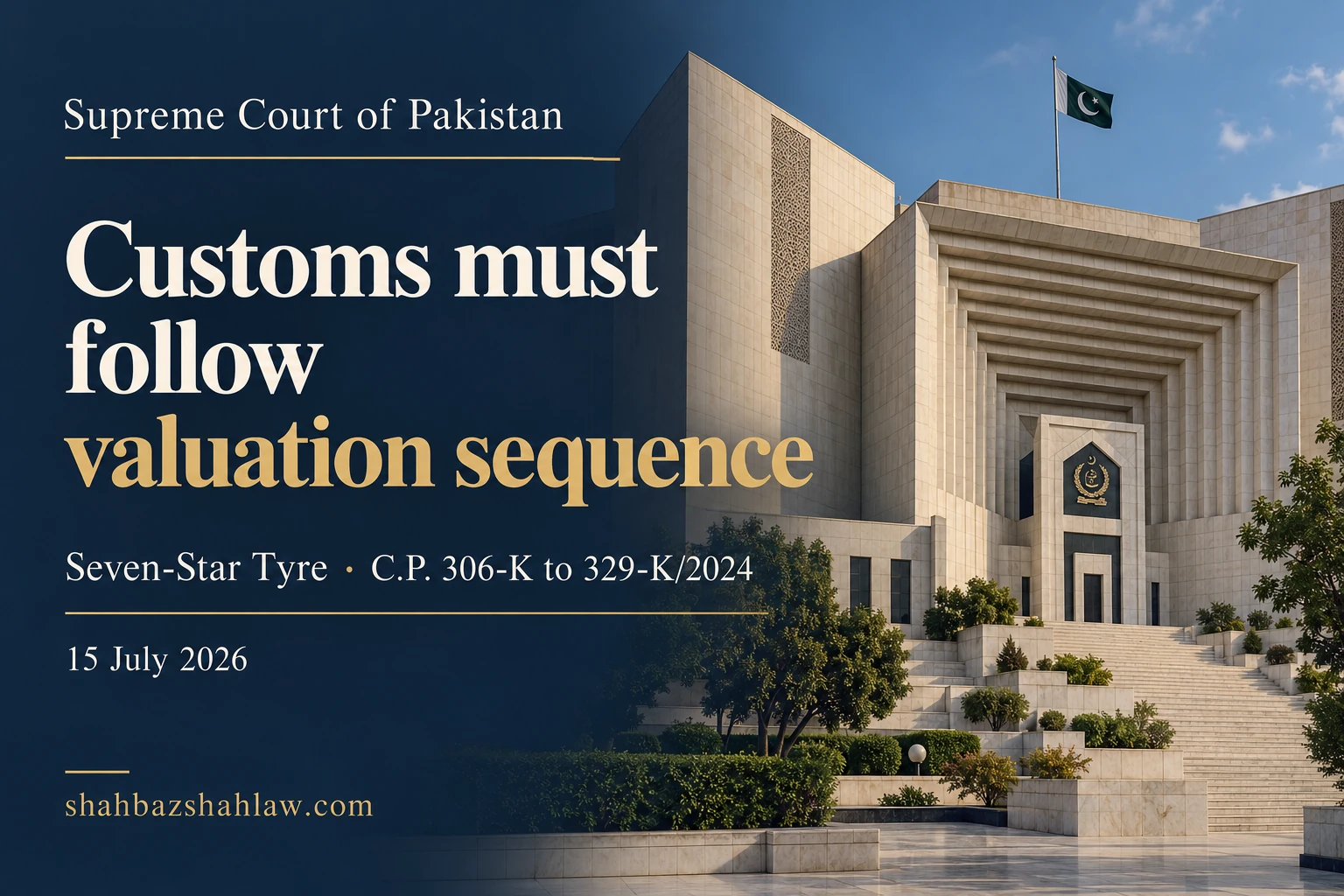
Customs had to follow the valuation sequence
The Supreme Court of Pakistan has restored the Customs Appellate Tribunal’s decision in favour of six tyre and tube importers after finding that Customs bypassed the valuation methods prescribed by section 25 of the Customs Act, 1969. The department could not move directly to the fallback method while disregarding uncontroverted import documents and failing to explain why the preceding methods could not apply. Judgment, paragraphs 8–11.
The decision in M/s Seven-Star Tyre and connected cases also reaffirms the limits of a customs reference before the High Court. The Tribunal’s supported factual findings could not be displaced summarily where the department had not competently raised a specific legal question attacking them as perverse or contrary to the record. Judgment, paragraphs 10–11.
The dispute over tyres and tubes
Twenty-four connected petitions arose from Valuation Rulings Nos. 1543/2021, 1544/2021 and 1545/2021, all dated 3 August 2021. They concerned tyres and tubes imported from China, Japan, Indonesia and Thailand. The importers included Seven-Star Tyre, Tyres Sales Corporation, Sultan Muhammad Tyre & Co., Autobax, Seven Star Old and New Tube and Tyre, and Tyre Master. Judgment, opening page and paragraphs 1–3.
The importers challenged the rulings through the statutory revision process. After the rulings were upheld, the dispute reached the Customs Appellate Tribunal, which allowed their appeals on 26 July 2022. The Tribunal held that the valuation exercise disregarded the Act and directed assessment on the declared values in the circumstances before it. The Sindh High Court reversed that result on 29 February 2024. Judgment, paragraphs 2–3.
The Supreme Court examined whether the documents established transaction value and whether Customs had a lawful basis for rejecting it and proceeding directly to fallback valuation. Judgment, paragraphs 4–8.
Why the import documents mattered
The importers relied on commercial invoices, bank letters of credit and exporters’ C&F price lists. These were material to their assertion of the actual transaction values. The Court noted that Customs had not produced reliable material showing that the documents were forged or fake, nor confronted the importers with adverse evidence justifying rejection of the declared values. Judgment, paragraph 8.
The Court did not simply accept an assertion that the papers existed. By an earlier order of 5 November 2024, it required each petitioner to place the documents on record to establish that they had been produced before the Tribunal. The documents were filed, supplied to departmental counsel and remained uncontroverted. That evidentiary history supported the Tribunal’s factual findings. Judgment, paragraphs 4 and 10.
The ruling therefore does not make every invoice conclusive. Its reasoning depends on the documents actually produced, the absence of a supported departmental rebuttal and the failure to apply the statutory valuation framework. Judgment, paragraphs 8–10.
Section 25 requires reasons before fallback valuation
The Court described transaction value under section 25(1) as the primary method. If the evidence is insufficient and Customs possesses concrete grounds to reject the declared value, the authority must address those grounds through the statutory process and proceed through the applicable methods in sequence. Judgment, paragraph 8.
For section 25(9), the judgment identified three connected requirements:
- The preceding methods in subsections (1), (5), (6), (7) and (8) must have been found inapplicable.
- The fallback exercise remains subject to the Customs Rules, 2001.
- The value must be derived through flexible application of the statutory valuation framework, rather than by pushing those methods aside.
Fallback valuation is accordingly a residual method reached through analysis. It is not permission to select an unsupported figure at the outset. Judgment, paragraph 8.
In these cases, the Tribunal found that the valuation authority had not specified why the earlier methods could not apply. The Supreme Court held that the resulting factual and legal conclusions were supported by the record and the structure of section 25. Judgment, paragraphs 9–11.
Sections 25A and 25D did not remove the methodological defect
The department’s proposed questions largely concerned the powers of the Director and Director General of Customs Valuation under sections 25A and 25D. The Supreme Court explained that the controversy was not simply whether those officials possessed power to issue or review a ruling. It concerned how the power had been exercised on the evidence in these particular cases. Judgment, paragraph 10.
A statutory power to determine customs value does not answer an objection that the decision disregarded the required valuation sequence. Likewise, identifying a review power does not dispose of an importer’s complaint that reliable transaction documents were rejected without an evidential basis. Judgment, paragraphs 8–10.
A reference is not a fresh factual appeal
The Court treated the Customs Appellate Tribunal as the final fact-finding forum. It cited its earlier decisions in Sargodha Spinning Mills, 2022 SCMR 1082, Middle East Construction Company, 2023 SCMR 838, and National Logistics Cell, 2023 SCMR 1325, when explaining that supported findings cannot be substituted merely because the High Court prefers another view. Judgment, paragraph 10.
A legally competent challenge remains possible where the findings are perverse, speculative or unsupported by the evidence. But the department must properly raise the relevant question of law. Here, it had not specifically formulated a challenge to the Tribunal’s findings on that basis. The High Court could not summarily discard them while deciding different questions concerning official powers. Judgment, paragraphs 10–11.
The result for the importers
The Supreme Court converted Civil Petitions Nos. 306-K to 329-K of 2024 into appeals and allowed them. It set aside the Sindh High Court decision of 29 February 2024 and restored the Tribunal’s judgment of 26 July 2022 for all the appellants. Justice Aqeel Ahmed Abbasi wrote the judgment, with Chief Justice Yahya Afridi and Justice Irfan Saadat Khan on the bench. The decision is dated 15 July 2026. Judgment, opening page and paragraph 11.
What importers and advisers should take from it
A useful challenge identifies both the documents proving transaction value and the missing steps in the authority’s reasoning. Counsel should connect the evidence to the valuation method, show how Customs treated it and identify whether the next methods were considered before fallback was used. These are practical implications of the Court’s analysis, rather than a guarantee that every declared value must be accepted. Judgment, paragraphs 8–10.
The decision should also be read alongside our analysis of the duration of customs valuation rulings. That case concerns whether a ruling expires merely after ninety days. Seven-Star Tyre concerns defects in the valuation methodology and treatment of evidence. A ruling’s continued operation and the legality of the method used to make it are separate questions.
Sources
- Supreme Court judgment and PDF download: M/s Seven-Star Tyre; M/s Tyres Sales Corporation; M/s Sultan Muhammad Tyre & Co.; M/s Autobax; M/s Seven Star Old and New Tube and Tyre; and M/s Tyre Master v. The Director General Customs Valuation / The Director General of Customs Valuation / The Collector of Customs (connected petitions), Civil Petition Nos. 306-K to 329-K of 2024, decided 2026-07-15.
- Full case details and judgment summary.
- Supreme Court official judgment register. Locate the case using its number and decision date.
Authorities discussed above are identified as applied or cited in this judgment.
Frequently asked questions
Can Customs use fallback valuation immediately?
Not by bypassing the preceding applicable methods. Section 25(9) requires the statutory sequence and the framework explained in the judgment. Read the judgment.
Were the importers’ invoices enough by themselves in every case?
The Court relied on the actual invoices, letters of credit and price lists, which remained uncontroverted, together with the absence of supported reasons for rejecting transaction value. It did not make every invoice conclusive. Read the judgment.
Can the High Court reconsider the Tribunal’s factual findings?
A competent legal challenge may address perversity or findings contrary to the record. A customs reference does not permit routine substitution of supported factual findings. Read the judgment.
What happened to the importers’ appeals?
All twenty-four petitions were converted into appeals and allowed. The Tribunal’s decision was restored. Read the judgment.
New judgment alerts
Follow this court or legal topic
Receive new judgments and analysis about Supreme Court of Pakistan, Commercial Law by email.
Primary-source materials
Verify the underlying law and record
Court documents, statutory provisions, official notifications, government documents, and external official sources relied on or relevant to this article.
M/s Seven-Star Tyre; M/s Tyres Sales Corporation; M/s Sultan Muhammad Tyre & Co.; M/s Autobax; M/s Seven Star Old and New Tube and Tyre; and M/s Tyre Master v. The Director General Customs Valuation / The Director General of Customs Valuation / The Collector of Customs (connected petitions)
customs-sequential-valuation-fallback-seven-star-tyre-supreme-court.pdf · PDF · 150 KB
Supreme Court official judgment register
Research integrity
Editorial and source record
- Author
- Shahbaz Shah, Advocate High Court
- Legal review
- Author-reviewed
- Sources checked
- October 26, 2026
- Primary materials
- 2 recorded on this page
- Corrections
- No material correction note is recorded.
Independent legal journal
Written and published by Shahbaz Shah
This article forms part of an independent journal focused on practical analysis of Pakistani law, courts, and legal institutions.
About the authorReader feedback
Was this analysis useful?
Choose one response and, if you wish, tell us what should be improved. No name or email is required. See the Privacy Policy.