Share this article
For more judgments and legal updates, follow our WhatsApp channel.
Independently written and published by Shahbaz Shah Legal Journal.
Case reference
Shaman / Shaukat Mahmood v. Syed Kamran Haider Gillani and others
- Reference
- Civil Appeals 231-L and 232-L of 2015 · Approved for reporting
- Court / judgment
- Supreme Court of Pakistan · 20 October 2026
- Bench / author
- Ayesha A. Malik J. and Shahid Waheed J.; judgment by Waheed J.
Missing purchasers’ signatures were not enough to invalidate the deed
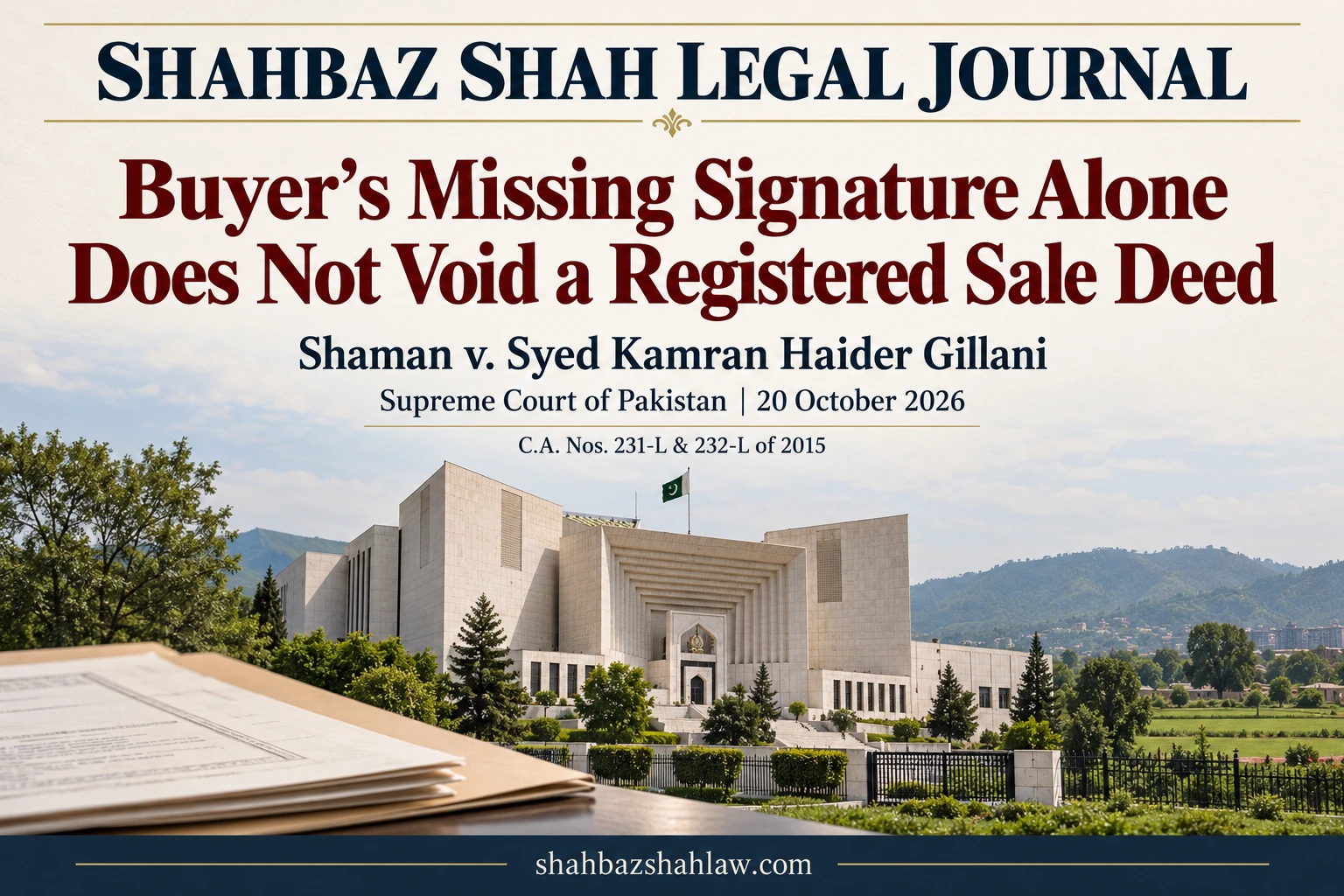
The Supreme Court of Pakistan has held that the absence of purchasers’ signatures or thumb impressions, standing alone, is not a ground for declaring a registered sale deed invalid. The Court distinguished a completed transfer of ownership from an agreement to sell and rejected the mechanical application of decisions concerning executory contracts. Judgment, paragraphs 23–25.
The ruling appears in the connected appeals of Shaman, deceased through his legal representatives, and Shaukat Mahmood and others against Syed Kamran Haider Gillani and others, Civil Appeals Nos. 231-L and 232-L of 2015. Justices Ayesha A. Malik and Shahid Waheed constituted the Bench. Justice Waheed authored the judgment dated 20 October 2026, marked approved for reporting in the supplied copy. Complete supplied judgment, pages 1 and 11.
The Court also examined fraud pleadings, the evidential weight of registration, protection for a pardanashin woman and a challenge brought nearly twenty-one years after the deed. Both appeals were allowed, and the decree dismissing the suit was restored. Judgment, paragraphs 10–29.
A 1976 sale was challenged in 1997
The dispute concerned 64 kanals and 1 marla of land. Mst. Nasreen Zohra claimed the property through inheritance and challenged registered sale deed No. 807 dated 10 May 1976, together with mutation No. 17 dated 9 October 1977. She alleged fraud and said she learnt of the transfer only shortly before approaching the court.
The purchasers maintained that she had sold the land voluntarily and received the agreed price. Her suit was filed on 8 May 1997. The Trial Court dismissed it on 23 December 2005, but the First Appellate Court reversed that decision on 23 August 2006. The Lahore High Court maintained the appellate decree on 22 June 2015. Judgment, paragraphs 1–8 and 27.
The Supreme Court’s examination was therefore concerned with both the legal approach to the deed and the evidential basis for disturbing a transaction acted upon over many years.
Fraud required pleaded facts and supporting evidence
The Court began with Articles 117 and 118 of the Qanun-e-Shahadat Order, 1984. A person seeking a judgment based on asserted facts must prove them. For a challenge to a registered instrument, merely using the word fraud does not discharge that initial burden.
It separated three tasks: pleading the material facts, producing evidence supporting them, and persuading the court that the challenge succeeds. Under Order VI Rule 4 CPC, allegations of fraud, misrepresentation or undue influence require particulars. A defendant must know what conduct is alleged and what case must be answered. Judgment, paragraphs 11–13.
On this plaint, the Court found no particulars identifying who committed the alleged fraud, when or how. The plaintiff asserted that she had never appeared before a competent officer, but did not specifically deny her thumb impression or receipt of consideration. She had not alleged collusion by the Sub-Registrar or a departure from the registration procedure. The Court held that the initial burden had not been discharged. Judgment, paragraph 14.
Registration carried a rebuttable presumption
The judgment linked the registration certificate with the duties of the registering officer under Sections 34, 35, 58 and 60 of the Registration Act, 1908. It also referred to Article 129(e) of the Qanun-e-Shahadat Order, under which courts may presume regular performance of official acts.
That presumption could be displaced by cogent evidence. It was not conclusive proof that fraud could never have occurred. Here, its weight was reinforced by the mutation, revenue record and possession over two decades. The plaintiff’s brother, examined as an attesting witness, supported execution in his presence. The Court found her uncorroborated statement insufficient on this record. Judgment, paragraphs 15–17.
The Court criticised the lower courts for asking whether the beneficiaries had proved the transaction before deciding whether the challenger had first established a case requiring that answer. Being the beneficiary did not, by itself, transfer every burden to the purchaser. Judgment, paragraph 18.
Protection for pardanashin women remained available on a properly pleaded case
The Court explained that the pardanashin doctrine protects a woman whose seclusion, illiteracy or dependence may affect her understanding or freedom of consent. The relevant inquiry is whether the transaction was her free and informed act. The judgment did not abolish that protection.
It identified several limits. The factual basis for invoking the doctrine must be pleaded and proved. The burden on a beneficiary varies with the transaction’s complexity and the relationship of trust. Independent advice is one way of showing understanding; the Court did not treat it as an indispensable condition in every transaction. Judgment, paragraphs 19–21.
In this case, the plaintiff had not pleaded that she was illiterate, that the deed was not explained to her, or that she was dominated by the purchasers. Her pleaded position was that she never appeared before the registering officer. The Court held that relief could not instead be founded on an unpleaded case of lack of understanding or consent. Judgment, paragraph 22.
The distinction is consequential: a genuine claim concerning a vulnerable executant must be examined on its pleaded facts, rather than either presumed to succeed or rejected merely because the deed is registered.
A sale deed and an agreement to sell serve different purposes
Applying Section 54 of the Transfer of Property Act, 1882, the Court distinguished a sale transferring ownership from a contract promising a future sale. An agreement to sell does not by itself create an interest in the property. A registered conveyance gives effect to the transfer.
The Court explained that the transferor’s execution is central to a sale deed, while the purchaser’s acceptance may appear from payment, acceptance of the deed, possession and mutation. The decisions relied on by the High Court concerned agreements to sell and could not mechanically establish that a registered conveyance required the purchaser’s signature. Judgment, paragraphs 23–24.
Paragraph 25 supplies the precise limit: missing purchasers’ signatures alone did not invalidate this deed. The Court expressly preserved the need to prove execution when genuinely and specifically denied, and challenges founded on fraud, want of consent or breach of a mandatory statutory requirement. It did not declare every registered deed valid regardless of its defects. Judgment, paragraph 25.
Recent discovery had to be pleaded and proved for limitation
The Court treated limitation as a separate obstacle. It applied Article 91 of the Limitation Act, 1908, prescribing three years for the instrument-cancellation claim considered, running from knowledge of the relevant facts. Section 18 addresses postponement where fraud has kept a person from knowledge of the right. Order VII Rule 6 CPC requires the plaint to state the ground relied upon for exemption from limitation.
The judgment distinguished execution, knowledge and institution as separate dates. It did not hold that registration automatically establishes the date of knowledge in every case. But a bare assertion that the transaction was discovered recently could not, without particulars and proof, postpone time. Judgment, paragraph 26.
The plaint did not explain two decades of claimed ignorance, what prompted the visit to the Patwari, or how the transaction had been concealed. Its assertion of possession was contradicted by the plaintiff’s admission that the purchasers were in possession. The Court held the suit time-barred and found no factual foundation for postponement under Section 18. Judgment, paragraphs 27–28.
This reasoning concerns the relief and facts examined in this case. It should not be converted into a statement that every inheritance or property suit has the same limitation period.
Trial Court dismissal restored
The Supreme Court set aside the High Court decree of 22 June 2015 and the First Appellate Court decree of 23 August 2006. It restored the Trial Court decree of 23 December 2005 dismissing the suit, with no order as to costs. The matter was not simply remanded for another trial. Judgment, paragraph 29.
For a challenger, the judgment highlights the need for precise fraud pleadings, evidence addressing the registration record, and a supported account of discovery where limitation is disputed. For a beneficiary, it confirms the significance of the deed and surrounding records while preserving properly founded challenges to execution and consent. These are practical implications of the Court’s reasoning, rather than a substitute for examining an individual transaction.
For related reading, see our report on fraud and the burden of proof in Khurram Rasheed.
Sources and document note
- Complete supplied judgment — 11-page PDF. This report is based on the attached judgment marked approved for reporting. No neutral or reporter citation is stated in that copy, and a separate direct court-hosted judgment PDF was not verified.
- Supreme Court of Pakistan — official case-information portal. Use Civil Appeals Nos. 231-L and 232-L of 2015 and the date 20 October 2026 to seek the court record.
- Supreme Court’s official cause-list publication for 19–23 October 2026. This is a listing source, rather than the judgment text.
- Judgment summary and full case particulars.
Frequently asked questions
Does a registered sale deed become invalid because the purchaser did not sign it?
Not on that ground alone. The Court distinguished a completed conveyance from an agreement to sell. It preserved challenges based on specifically denied execution, fraud, absence of consent or breach of a mandatory legal requirement. Judgment, paragraphs 23–25.
Can a registered deed still be challenged for fraud?
Yes. Registration creates a rebuttable presumption rather than immunity. The challenger must plead the material particulars of fraud and support the case with evidence capable of displacing that presumption. Judgment, paragraphs 11–18 and 25.
Did the judgment abolish protection for pardanashin women?
No. The Court explained that the doctrine protects understanding and free consent. Its factual basis must be pleaded and proved; it does not replace the need to plead the case on which relief is sought. Judgment, paragraphs 19–22.
When does the three-year period under Article 91 begin?
For the instrument-cancellation claim considered here, the Court stated that time runs from knowledge of the facts entitling cancellation. A claim of later discovery must be particularised and proved; the Court did not make registration the automatic starting date in every case. Judgment, paragraphs 26–28.
Does alleging fraud automatically defeat limitation?
No. The Court required a factual foundation for postponement under Section 18, including how fraud kept the plaintiff from knowledge of her right. A bare claim of recent discovery did not suffice on this record. Judgment, paragraphs 26–28.
What was the final result?
Both appeals were allowed. The High Court and First Appellate Court decrees were set aside, and the Trial Court decree dismissing the suit was restored. There was no order as to costs. Judgment, paragraphs 29.
New judgment alerts
Follow this court or legal topic
Receive new judgments and analysis about Supreme Court of Pakistan, Civil Law, Evidence by email.
Primary-source materials
Verify the underlying law and record
Court documents, statutory provisions, official notifications, government documents, and external official sources relied on or relevant to this article.
Shaman (deceased) through his L.Rs. and others v. Syed Kamran Haider Gillani and others; connected: Shaukat Mahmood and others v. the same respondents
shaman-shaukat-mahmood-ca-231-232-l-2015-20-october-2026-supplied-judgment.pdf · PDF · 41 KB
Supplied 11-page judgment — Civil Appeals 231-L and 232-L of 2015, 20 October 2026
Supreme Court of Pakistan — official case-information portal
Supreme Court of Pakistan — official cause-list publication for 19–23 October 2026 (listing source)
Research integrity
Editorial and source record
- Author
- Shahbaz Shah, Advocate High Court
- Legal review
- Author-reviewed
- Sources checked
- October 22, 2026
- Primary materials
- 4 recorded on this page
- Corrections
- No material correction note is recorded.
Independent legal journal
Written and published by Shahbaz Shah
This article forms part of an independent journal focused on practical analysis of Pakistani law, courts, and legal institutions.
About the authorReader feedback
Was this analysis useful?
Choose one response and, if you wish, tell us what should be improved. No name or email is required. See the Privacy Policy.