Share this article
For more judgments and legal updates, follow our WhatsApp channel.
Independently written and published by Shahbaz Shah Legal Journal.
Case reference
Case reference
- Case
- Sri Sujit Das and Others etc. v. Union of India
- Reference
- 2026 INSC 1195 · 5 November 2026
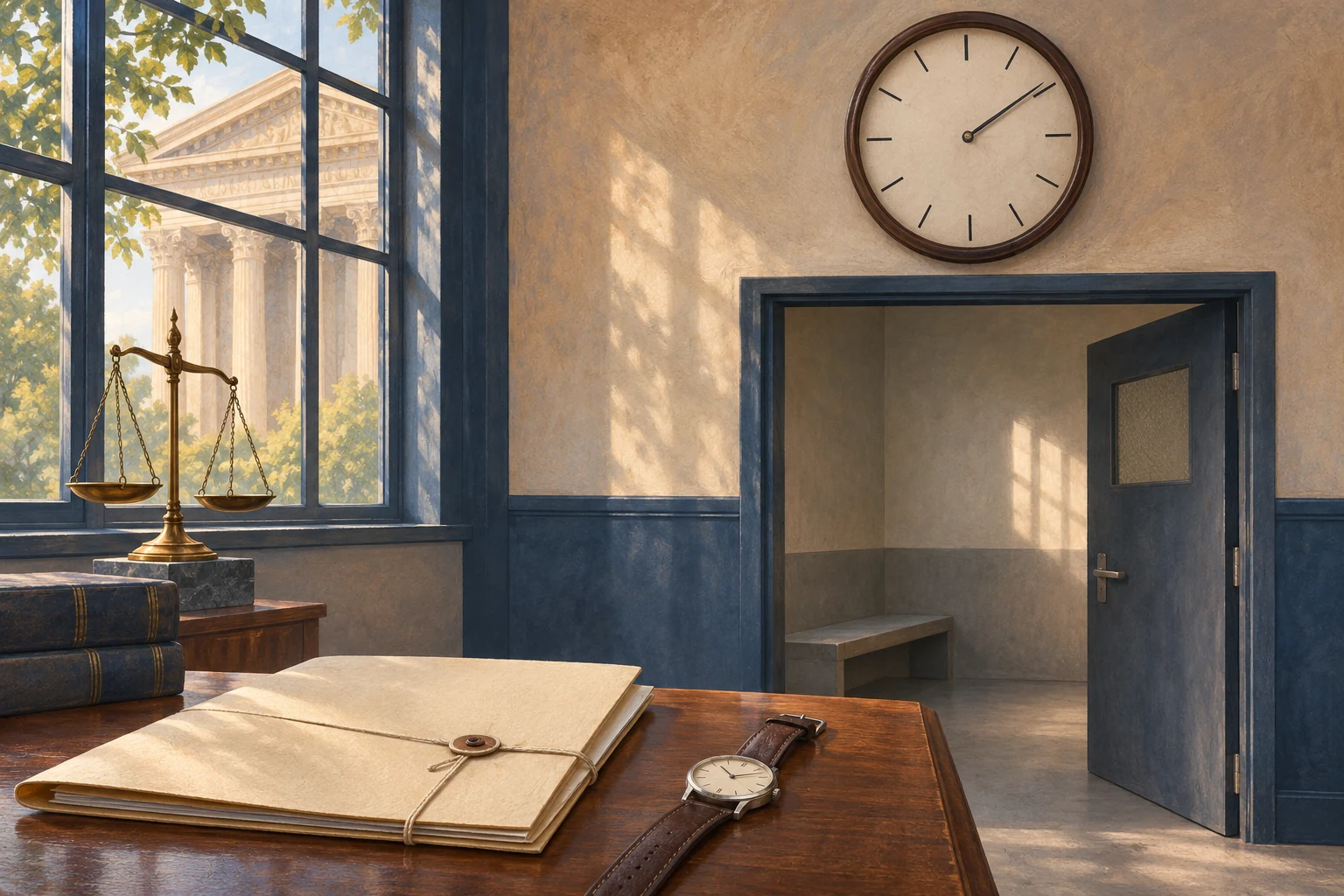
An investigating agency cannot postpone the constitutional deadline for producing a detainee before a magistrate by recording the arrest later. In Sujit Das v. Union of India, the Supreme Court held that the 24-hour period begins when the person actually loses liberty and comes under the agency’s control. It granted relief to three appellants in an NDPS case and directed magistrates to examine the real detention time. Judgment, paragraphs 58–60 and 69.
The 5 November 2026 judgment was delivered by Justice Ujjal Bhuyan on a bench with Justice Atul S. Chandurkar. Its reach extends beyond the date written on an arrest memo: officers must comply with the production deadline, and the magistrate must verify compliance rather than accept the paperwork mechanically. Paragraphs 60 and 69(vi)–(vii).
The hours that decided the appeal
Customs officers alleged that they recovered Yaba tablets from a truck and a person who approached it on a motorcycle in Tripura. Their account placed the total seizure at 60.79 kg. Sujit Das, Suman Das and Rupak Sarkar challenged the rejection of bail; a fourth accused was mentioned in the seizure narrative. The Court was deciding custody and bail, without determining guilt on the narcotics allegations. Paragraphs 3–9.
For its decision, the Court used the following sequence from the respondent’s account:
- 29 September 2025, 2 pm: the appellants were intercepted and their liberty came under the search team’s control.
- 29 September, 5 pm: the search and seizure procedure at the Customs office concluded.
- 30 September, 11 am and 11.15 am: the formal arrests were recorded.
- 30 September, 4.45 pm: the appellants were produced before the Judicial Magistrate.
The agency argued that time spent searching, weighing, testing, questioning and completing formalities should fall outside the constitutional calculation. The Court rejected that position and found that production should have occurred before 2 pm on 30 September. Paragraphs 65–67.
Actual restraint starts the clock
Article 22(2) requires production before the nearest magistrate within 24 hours, excluding the necessary journey time from the place of arrest to the magistrate’s court. The Court held that the protection turns on actual deprivation of liberty. An agency cannot suspend it by describing an individual as merely detained for investigation while withholding the formal arrest entry. Paragraphs 16, 43 and 58–59.
The judges rejected the argument that NDPS procedures create a period of investigative custody outside Article 22(2). Section 67 inquiries and the search and inventory rules do not prevent timely production before a magistrate. Procedures can continue under lawful judicial supervision; they do not supply a fresh exception to the constitutional deadline. Paragraphs 40 and 43.
The judgment expressly disapproved the contrary interpretations in the Orissa High Court’s Aryaman Pattnayak, the Madras High Court’s Kannan and the Kerala High Court’s Arun K. Thomas. The disapproval concerns their interpretation of Article 22(2). Paragraph 69(iv).
Twenty-four hours is also subject to reasonableness
Section 58 BNSS, carrying forward Section 57 CrPC, imposes a second safeguard. Even within the 24-hour ceiling, detention without a warrant must not last longer than is reasonable in the circumstances. The magistrate may decline remand where the period already spent in custody was unreasonable. Paragraphs 17–20 and 60.
Here, the search had ended at 5 pm but formal arrests were shown only the following morning. The Court found no explanation for the roughly 18-hour interval. It treated that unsupervised period as unreasonable as well as finding a breach of the separate 24-hour production rule. Paragraph 67.
What magistrates must check
The operative conclusions require the magistrate to record the actual date and time when liberty was curtailed, calculate the deadline from that point and examine whether the person was produced in time. A breach requires release from detention. The magistrate must also examine whether a period inside the ceiling was nevertheless unreasonably long. Paragraph 69(vi)–(vii).
For counsel, the practical task is to reconstruct the custody chronology from the first restraint, seizure papers, office arrival, arrest memo and production record. This is a preparation point drawn from the documents and competing timelines the Court examined. A formal arrest entry cannot by itself resolve a dispute about earlier custody. Paragraphs 10–13 and 65–69.
The bail order and the Section 37 discussion
The Tripura High Court had relied on the NDPS Act’s restrictive bail conditions. The Supreme Court expressed reservations about observations in Sukhwinder Singh concerning the relationship between Article 21 and Section 37, referred to larger-bench authority, and distinguished that case because Article 22(2) was not in issue there. The judgment should not be described as formally overruling Sukhwinder Singh. Paragraphs 48–49.
The Court set aside the High Court’s order. Its case-specific direction requires production of the appellants before the jurisdictional Special Court within a maximum of seven days, followed by release on bail on terms considered appropriate. That is the mechanism specified in the operative order, alongside the judgment’s general requirement of release where the production deadline is breached. Paragraphs 68–71.
The judgment also directs circulation to State and Union Territory police chiefs, High Court Registrar Generals and State Judicial Academy Directors. The focus remains the initial custody period and scrutiny at first production; it does not impose a 24-hour limit on all detention under a valid judicial remand. Paragraphs 16–20 and 69–70.
Sources and case reference
- Searchable judgment summary and full case details.
- Complete Supreme Court of India PDF, 97 pages.
- Supreme Court of India judgment collection.
Frequently asked questions
When does the 24-hour production period begin?
It begins when the investigating authority actually detains the person and curtails liberty, even if the formal arrest is recorded later. Judgment, page 94.
What time may be excluded from that calculation?
Only the time necessary for the journey from the place of arrest to the magistrate’s court. The Court rejected additional exclusions for search, seizure, questioning or paperwork. Judgment, page 95.
Can detention be unlawful even before 24 hours expire?
Yes. Section 58 BNSS also requires the period to be reasonable in the circumstances. The magistrate may decline remand if custody has already lasted unreasonably long. Judgment, page 86.
What must the magistrate record?
The actual date and time of detention when liberty was curtailed, followed by an examination of both the production deadline and the reasonableness of the custody period. Judgment, page 95.
How did the Court direct these appellants to be released?
It ordered their production before the jurisdictional Special Court within a maximum of seven days from the judgment, after which they were to be released on bail on appropriate terms. Judgment, page 97.
Did the judgment acquit the appellants of the narcotics charges?
No. It allowed the appeals concerning custody and bail and set aside the High Court’s bail rejection. It did not determine guilt on the underlying charges. Judgment, page 97.
New judgment alerts
Follow this court or legal topic
Receive new judgments and analysis about Supreme Court of India, Criminal Law, Constitutional Law by email.
Primary-source materials
Verify the underlying law and record
Court documents, statutory provisions, official notifications, government documents, and external official sources relied on or relevant to this article.
Sri Sujit Das and Others etc. v. Union of India
sujit-das-2026-insc-1195.pdf · PDF · 531 KB
Official Supreme Court of India PDF
Research integrity
Editorial and source record
- Author
- Shahbaz Shah, Advocate High Court
- Legal review
- Author-reviewed
- Sources checked
- November 5, 2026
- Primary materials
- 2 recorded on this page
- Corrections
- No material correction note is recorded.
Independent legal journal
Written and published by Shahbaz Shah
This article forms part of an independent journal focused on practical analysis of Pakistani law, courts, and legal institutions.
About the authorReader feedback
Was this analysis useful?
Choose one response and, if you wish, tell us what should be improved. No name or email is required. See the Privacy Policy.