Share this article
For more judgments and legal updates, follow our WhatsApp channel.
Independently written and published by Shahbaz Shah Legal Journal.
Case reference
Tejaram v. State of Rajasthan
- Reference
- 2026 INSC 1147 · Criminal Appeal 4988/2026 · SLP (Crl.) 11709/2025
- Court / judgment
- Supreme Court of India · 16 October 2026 · Reportable
- Bench / author
- S.V.N. Bhatti J. and N.V. Anjaria J.; judgment by Anjaria J.
Alleged bribe demand fell outside Section 17A protection
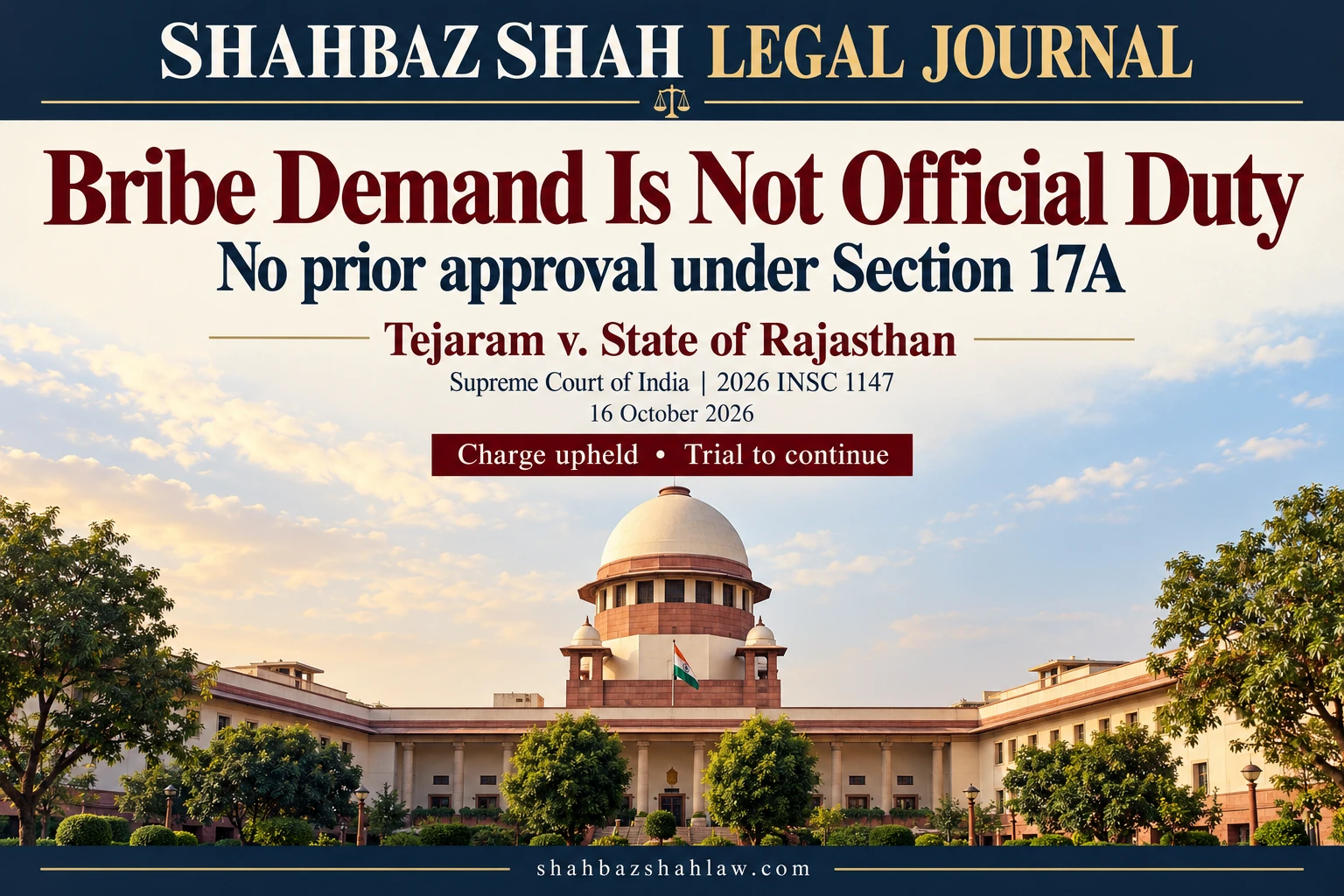
NEW DELHI: The Supreme Court of India has held that prior approval under Section 17A of the Prevention of Corruption Act, 1988 was not required to investigate a police constable’s alleged demand for a bribe. The Court reasoned that demanding illegal gratification was unrelated to a recommendation or decision made in discharge of official duties. Judgment, paragraphs 6–6.3 and 10.
The reportable decision in Tejaram v. State of Rajasthan, 2026 INSC 1147, was delivered on 16 October 2026 by Justices S.V.N. Bhatti and N.V. Anjaria. Justice Anjaria authored the judgment. It dismissed the appeal against an order upholding the framing of a charge under Section 7. Official judgment.
The result permits the criminal proceedings to continue. It is not a conviction or a final finding that the alleged bribe was demanded. Paragraph 8 expressly leaves the trial to be conducted on its merits, with both sides entitled to raise their contentions. Judgment, paragraphs 8–11.
Complaint followed a dispute between two constables
Tejaram was posted at the office of the Deputy Superintendent of Police, Sirohi, Rajasthan. The complainant, Devendra Kumar, was also a constable. The judgment records Tejaram’s case that he had earlier accused the complainant of taking illegal gratification during an investigation-related visit to Madurai.
Tejaram alleged that the complainant retaliated by sending a false email to the Anti-Corruption Bureau on 22 April 2021. The complaint accused Tejaram of demanding INR 1.5 lakh in the name of the Superintendent of Police. These were rival allegations recounted by the Court, rather than findings resolving which account was true. Judgment, paragraphs 3–3.1.
FIR No. 174 of 2021 was registered on 4 June 2021 under Section 7A of the Prevention of Corruption Act and Section 120B of the Indian Penal Code. The subsequent chargesheet and the charge challenged in these proceedings concerned Section 7. The distinction between the initial FIR provisions and the later charge should be preserved. Judgment, paragraphs 3.1–3.3 and 5.
Challenge concerned the authority to investigate
The Special Judge, Anti-Corruption Bureau, Pali, ordered the framing of a charge on 12 September 2024 in Sessions Case No. 2 of 2024. The Rajasthan High Court at Jodhpur dismissed Criminal Revision Petition No. 1608 of 2024 on 26 March 2025. Tejaram then approached the Supreme Court. Judgment, paragraphs 2–3.3.
His principal argument was that investigators had not obtained the previous approval required by Section 17A. He maintained that the provision was mandatory and that the omission could not be repaired later. The State responded that the alleged bribe demand was a criminal act unrelated to an official recommendation or decision, so the provision did not apply. Judgment, paragraphs 4–4.2.2.
Section 17A requires a connection with an official decision
The Court reproduced Section 17A and identified the conditions governing its operation. The alleged offence must be under the Prevention of Corruption Act and must relate to a recommendation made or decision taken by the public servant in discharge of official functions or duties. Where those conditions are satisfied, previous approval must come from the authority identified in the provision. Judgment, paragraphs 5.1–5.1.2.
The inquiry therefore does not end with the person’s designation or employment. The relationship between the alleged conduct and an official recommendation or decision is central. The Court rejected treating Section 17A as an automatic protection covering everything a public servant is accused of doing. Judgment, paragraphs 6–6.1.
The provision also contains an express exception for cases involving arrest on the spot on a charge of accepting or attempting to accept an undue advantage. That proviso is distinct from the prior question whether the alleged conduct falls within Section 17A at all. In Tejaram, the decisive reasoning was that the alleged bribe demand had no relevant connection with an official recommendation or decision. Judgment, paragraphs 5.1.2 and 6–6.3.
A bribe demand was not the discharge of an official function
Applying those conditions, the Court held that the allegation of demanding INR 1.5 lakh concerned a criminal act unrelated to Tejaram’s official duties. It could not be treated as a decision or recommendation made in discharge of those duties. Section 17A accordingly did not apply, and the absence of approval under that provision did not invalidate the initiation of proceedings. Judgment, paragraphs 6.1–6.3 and 10.
The Court drew support from earlier decisions concerning bribe demands and the limits of Section 17A. Its reasoning addressed the nature of the allegation and the statutory connection with official functions. It did not decide the evidential questions the prosecution would have to establish at trial. Judgment, paragraphs 5.2–5.5.1 and 8.
Section 19 prosecution sanction remained a separate question
The judgment records that sanction for prosecution under Section 19 was granted on 8 December 2023, followed by the chargesheet dated 19 January 2024. In paragraph 8, the Court addressed the argument that sanction had been obtained belatedly. It noted that sanction had been taken before cognizance and held that the timing objection did not vitiate the proceedings on these facts. Judgment, paragraphs 5 and 8.
That reasoning should not be reported as dispensing with Section 19 sanction in every bribery prosecution. Nor did the Court hold that later Section 19 sanction cures an otherwise applicable Section 17A requirement. Its primary conclusion was that Section 17A never applied to the alleged conduct in this case.
For a separate Indian ruling concerning the stage at which prosecution sanction operates, see our report on Section 197 CrPC and investigation in Rajesh Reddy. The provisions must be examined individually; they should not be combined into a single approval rule.
Larger-bench reference did not prevent deciding this appeal
Counsel referred to the larger-bench proceedings concerning Section 17A’s validity. The Supreme Court said it need not await that reference because the provision was inapplicable to the facts before it. The judgment therefore resolves this appeal through statutory interpretation without determining the constitutional validity of Section 17A. Judgment, paragraph 7.
Charge upheld; merits left for trial
The Supreme Court upheld the High Court’s decision and dismissed the appeal. Its holding was that want of Section 17A approval had not invalidated the criminal proceedings. The charge under Section 7 remained in place, and the trial could proceed on its merits. Pending interlocutory applications did not survive the dismissal. Judgment, paragraphs 8–11.
For counsel, the practical lesson is to identify the precise alleged act and its connection with an official recommendation or decision before advancing a Section 17A objection. Approval for investigation, sanction for prosecution and proof of guilt answer different questions. This is a practical reading of the judgment, not a substitute for examining the allegations and procedural record in an individual case.
For Pakistani readers, this is an Indian statutory ruling. Its interpretation of Sections 17A and 19 should not be presented as the governing Pakistani sanction framework. Its comparative value lies in the Court’s treatment of the connection between an alleged offence and official duty.
Sources and case reference
- Supreme Court of India — complete official 17-page judgment, 2026 INSC 1147.
- Supreme Court of India — official judgment viewer, Diary No. 38471/2025.
- Supreme Court of India — official listing, identifying Criminal Appeal No. 4988/2026 and upload on 16 October 2026 at 18:19:02 IST. The appeal-number space on the signed PDF’s first page is unfilled; it identifies SLP (Criminal) No. 11709 of 2025.
- Official judgment-date search. Search 16 October 2026 and Tejaram.
- Downloadable copy of the unchanged official judgment.
- Judgment summary and full case particulars.
Frequently asked questions
What did the Supreme Court decide in Tejaram’s case?
It held that Section 17A did not apply to the alleged demand for a bribe because the conduct was unrelated to a recommendation or decision made in discharge of official duties. The appeal against the order upholding the charge was dismissed. Judgment, paragraphs 6–6.3 and 9–11.
Does being a public servant automatically require prior approval for investigation?
No. The Court required a connection between the alleged offence and a recommendation or decision made in discharge of official functions. Public-servant status alone did not satisfy Section 17A. Judgment, paragraphs 5.1–5.1.2 and 6–6.3.
Was Tejaram convicted by the Supreme Court?
No. The case concerned a challenge to the framing of a charge. The trial was to proceed on its merits, with the parties free to raise their rival contentions. Judgment, paragraphs 8–11.
How are Section 17A approval and Section 19 sanction different in this case?
Section 17A concerned approval before investigation in the circumstances it covers. Section 19 concerned sanction for prosecution. The Court found Section 17A inapplicable and noted that Section 19 sanction had been obtained before cognizance. Judgment, paragraphs 5, 5.1 and 8.
Was the decision confined to a person caught accepting a bribe on the spot?
The judgment discusses the separate on-the-spot arrest proviso. Its application to Tejaram rested on the absence of an official recommendation or decision to which the alleged bribe demand related. Judgment, paragraphs 5.1.2 and 6–6.3.
Did the Court decide the constitutional validity of Section 17A?
No. It said the larger-bench reference did not prevent deciding this appeal because Section 17A was inapplicable on the facts before it. Judgment, paragraphs 7.
New judgment alerts
Follow this court or legal topic
Receive new judgments and analysis about Supreme Court of India, Criminal Law, Legal Profession by email.
Primary-source materials
Verify the underlying law and record
Court documents, statutory provisions, official notifications, government documents, and external official sources relied on or relevant to this article.
Tejaram v. State of Rajasthan
tejaram-state-rajasthan-2026-insc-1147-official-judgment.pdf · PDF · 247 KB
Supreme Court of India — official 17-page judgment, 16 October 2026
Supreme Court of India — official judgment viewer, Diary 38471/2025
Supreme Court of India — official case listing and upload details
Supreme Court of India — official judgment-date search
Research integrity
Editorial and source record
- Author
- Shahbaz Shah, Advocate High Court
- Legal review
- Author-reviewed
- Sources checked
- October 22, 2026
- Primary materials
- 5 recorded on this page
- Corrections
- No material correction note is recorded.
Independent legal journal
Written and published by Shahbaz Shah
This article forms part of an independent journal focused on practical analysis of Pakistani law, courts, and legal institutions.
About the authorReader feedback
Was this analysis useful?
Choose one response and, if you wish, tell us what should be improved. No name or email is required. See the Privacy Policy.